27 March, 2010

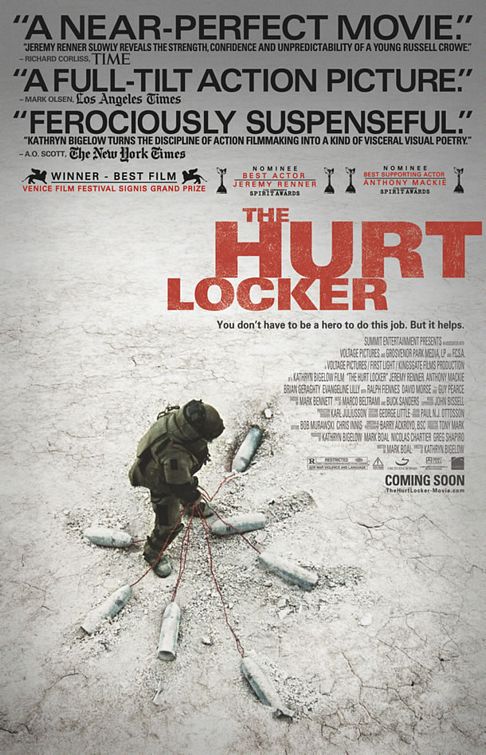
The Hurt Locker (2009)

Here's a film I've been meaning to see since about November that I just today finally got around to seeing. Unfortunately, the quality of the film did not correspond too well with my desire to see it. Hurt Locker is far from a bad movie, but it's also not at risk of being a masterpiece.

If I could describe Hurt Locker in as few words as possible, I would just call it a fantastic war movie. However, that's much different than calling it a fantastic movie. Apocalypse Now! is a movie set during a war, but I would never think of it as a war movie, because the inner struggles of the lead characters are so much more important than the actual war story. Same goes for a movie like The Thin Red Line or Rescue Dawn.

That isn't the case with Hurt Locker. The characters are all pretty well rounded, but almost all of the character development is saved until about the last half hour when all the characters have to suddenly come to terms with various issues. When resolution for the lead character finally comes, it's delivered in an unfortunately heavy handed speech to an infant while holding a jack-in-the-box. Best Picture material, naturally.

So, war movie. Under this criterion, the film shines gloriously. The audience never has to deal with dull generals, no scenes depict officials trying to create the perfect plan to defeat the enemy, nothing of that sort occurs. Instead, there is the simple concept that everyday brings new challenges, and in war, this means life or death. That makes the movie tense, as it often is. The movie follows a unit that neutralizes bombs (which the opposing forces seem all too willing to take their time in detonating).

I don't really know much about Kathryn Bigelow, but her direction here is pretty top notch (a quick glance at Wikipedia informs me that 1) she directed that surfer movie with Keanue Reaves, and 2) she was married to James Cameron, no doubt 2 mistakes). The cinematography is really quite excellent, and even the firefight scenes aren't especially dull thanks to the camera work.

As a film, I have no real complaints about The Hurt Locker. It's not a bad movie. I would even call it a good movie, but nothing more. It's not incredibly unique in its approach, but at least it isn't entirely riddled with cliche. Also, any movie that takes awards away from Avatar is fine by me. I think it fails in its lofty attempts to be a brainy war flick, but succeeds in separating itself from the glut of action heavy war movies. I would put it on par with a movie like Jarhead, which I actually thought was surprisingly good.

19 March, 2010

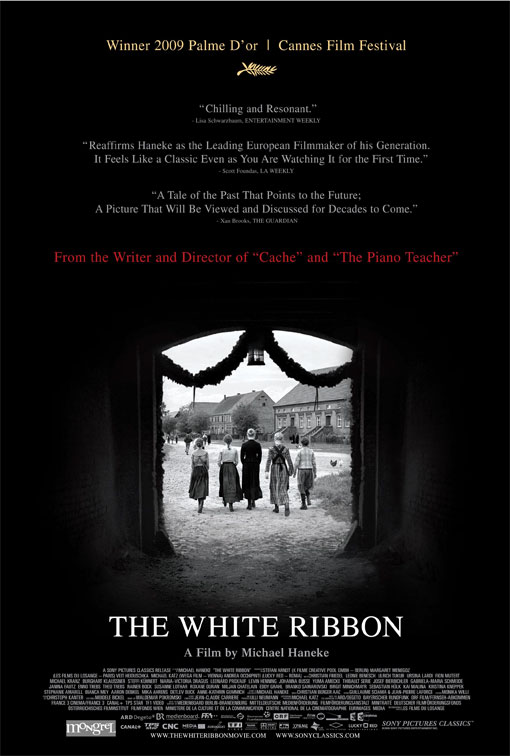
Das weiße Band (The White Ribbon) (2009)

Michael Haneke, to put it lightly, is difficult. His newest feature, (which unfortunately just came to Eugene this week) Das weiße Band, 2009 Golden Palm winner at Cannes, is no exception. The only way I know how to describe it is imagining Bela Tarr had directed Haneke's earlier film Cache, which made a surprising number of best films of the 00's lists.

The film moves at a very deliberate pace, yet never fails to engage. All the characters are fully developed. The dialogue is natural. The acting is tremendous, especially considering the extensive use of child actors in key roles.

It's the last point that I find most entrancing about the film (other than the spectacular camera work, a strong point in any Haneke film). The ensemble cast consists of a large number of children, and their acting generally outshines all but a few of their adult counterparts. Interestingly, the intrigue of the ability of these child actors is reflected in the perplexing narrative, which remains up for interpretation, as is generally the case in Haneke's films.

The movie itself tells the tale of a small German town on the eve of the first world war (a fact that's never really made clear until a character learns of Ferdinand's assassination about 2/3 of the way into the movie). In the town, a number of unexplained accidents happen, and the locals are terrified.

The viewer is left with nothing with questions by the end of the film. Like other Haneke films, the ultimate question is whether or not the questions the audience likely leaves with matter in the first place (I'm being intentionally vague in this review so as not to spoil anything). By not bringing reconciliation in an expected way, Haneke is really attacking the very cinematic idea of closure.

Haneke is a master filmmaker, and this is him at his finest. I'm not going to suggest that I was utterly blown away by the time the credits ran, but this movie really was next to perfect. From the preview, this made me think it would be something like The Village, without being awful. And in actuality, that's kind of what it was. Haneke presents the same kind of small village paranoia in a subtle way incomprehensible in mainstream American film as of late.

Given how incredibly excellent this film was (though, ultimately, I don't think it unseated Antichrist as my favorite film of 2009), I'm really excited to see
El secreto de sus ojos, which nabbed the Oscar for best foreign language film this year (at which point I turned off the TV to avoid having to look at James Cameron anymore).

15 January, 2010

Festen (The Celebration) (1998)

In 1995, Thomas Vinterberg and Lars von Trier released the Dogme 95 manifesto into the cinema world by means of flyers thrown at a Parisian audience during a talk von Trier was giving to commemorate the first century of film history. The most prominent feature of the manifesto (one of many that von Trier has written) is the "Vow of Chastity", which is a sort of 10 commandments for film. The list is simply ridiculous, with rules like cameras must be handheld (preferably digital), all music must be recorded live, no props are allowed unless they are found on the site, everything must be filmed on site, and greatest of all, the director can never be credited.

In 1998, Dogme #1 was released, Thomas Vinterberg's The Celebration. Dogme actually had a board certify the films, which can be found in numeric order on their website (though the group has since disbanded).

The Vow was intended to reintroduce the element of realism into film (assuming it wasn't simply an elaborate prank being played by von Trier and co, seeing as how many of the Dogme founders never directed more than one Dogme film). However, it simply works as a stylistic guide for a specific aesthetic. Were the Dogme filmmakers really concerned with the lack of realism in Hollywood movies, the omission of any rules related to editing seem to negate any attempted realism (jump cuts aplenty!).

With all of that said, Vinterberg's debut feature is an absolute gem. Winner of the Jury prize at Cannes that year, Festen was justly praised on its release. No matter how gimmicky the Dogme "movement" was, films like this almost justify its extravagant scope (I'm sure there are plenty of Dogme duds, but so far, I've seen 3 and loved them all).

As for the film itself, I think it might just be one of the most depressing pieces put to film. The movie is about a family and their friends gathered for the 60th birthday of their patriarch. Like all Danish families, no doubt, this one has an unbearably dark past. Just minutes into the film, we discover that the father's grown children, spread out in various walks of life, are recently recovering from the death of a sister. Her twin seems the most rattled, while the youngest brother apparently didn't even attend the funeral. Domestic squabbles and family revelations abound in this film.

The setup of the film reminds me very much of France's golden cinema cow, Jean Renoir's La Règle du jeu, a film whose reputation I've never quite agreed with, but is a worthwhile watch anyway. Basically, there is a house full of people who have unknowingly agreed to enjoy themselves no matter what, and one rebel who is out to reveal the demon in the crowd.

What makes Festen so successful is a few things. One is the stylized look, naturally. What would become trite in just a few years was new and fascinating at this point. Secondly, the utterly fantastic characters, who are more well rounded, flawed, tragic than any film I can recall. Finally, the unrestrained content of the film is really shocking. The issues discussed in this movie (which I will not speak too much of, I would much rather you see the film for yourself, and say "Oh my god!" just as I did) are simply not addressed in films, and I really wonder why.

What really shocked me about the movie, other than the family secrets being revealed, was the very subtle humor. While I would gladly describe the movie as utterly depressing, it definitely doesn't go without taking a few jabs here and there, and by the end, you kind of hate Danish people. Well, more than you already, naturally do.

12 January, 2010

The Imaginarium Of Doctor Parnassus (2009)

Terry Gilliam makes a movie with "Imaginarium" in the title and casts Tom Waits as the devil. This sounds as close to a slam dunk as a movie can be. Unfortunately, Parnassus is more of a shot clock violation. The ideas get passed around so much that Gilliam forgets to take a shot.

There is a lot to like in Gilliam's newest film, from the exquisite cast (minus Verne Troyer, who delivers his witty lines like a particularly bland board), to the premise of the film, which involves an immortal monk making wagers with Mr. Nick/Satan to protect his family, while the rest of the cast gets to spend a lot of their time inside a fantasy land.

However, the fantastic elements just aren't that imaginative. Maybe it was just CGI overkill, but I found the film to be at it's least interesting in the dream-like imaginarium, which should really be Gilliam's strength. And as dull as I found Avatar, that technology showcase masquerading as a narrative, actors submersed in CGI landscapes in any other movie just looks silly in comparison. Watching this after watching James Cameron's film, which undoubtedly cost the GDP of various small countries was like watching Jurassic Park on TV. Had this film not relied so heavily on these technical elements, it could have been much stronger, but instead gets handicapped by its already dated appearance.

I would consider myself a fan of Gilliam's work. Brazil is one of my absolute favorite films (watch for Brazil lead Jonathan Pryce to make a brief cameo during Parnassus). It's a well established fact that Gilliam knows his way around an imagination as only someone like Tim Burton could hope for (the jury is still out on whether Gilliam or Burton will make Johnny Depp: The Movie first). But Parnassus seems more like the uninspired work of latter day Burton than Gilliam, minus the fact that it's not a remake (not that Gilliam has been at the top of his game lately, and I'll admit to greatly enjoying Sweeney Todd).

All in all, Parnassus is a surprisingly tight narrative, with generally good acting, but it just never really becomes anything great. It's not Gilliam's worst film, but it's far from his best. I think of this more as a step in the right direction than a great movie. Gilliam is indeed returning to the silliness and imagination of his older movies, it's just a matter of quality that's the issue.

29 December, 2009

Avatar (2009)

Stock characters, heavy handed political messages, and ghastly production costs. This is indeed a James Cameron film. I will admit that I genuinely think Titanic was a piece of filmmaking brilliance, and Aliens was pretty good as well, but for me, Cameron's ability to make an interesting movie ends there.

Avatar is essentially Last of the Mohicans, Fern Gully and She's All That, made in Three Dimensions(!!!!). As a technical piece, it is unmatched in its visual spectacle. The movie just looks absurdly good. It's genuinely unsettling how detailed everything about the movie is.

At least everything about the movie that doesn't relate to characters or story. Other than the final battle scene, and just the general look of the film, there is really no redeeming quality to the movie.

The characters are characters you've seen from the last action movie you saw. They deliver the lines they are supposed to and either succeed or die in the end, though it's clear who does what. I cringed when the main character had to give his heart to heart to his lady interest that it only started out as a job, but he really was in love, with all the syrupy Freddie Prince Jr. sweetness he could muster.

I can't say I wouldn't recommend this movie, because it was a treat for my eyes. But paying $10 or whatever IMAX is charging to see it only encourages directors to keep producing these kinds of dull experiments in spending as much money as possible. And seeing as I paid to see this and Transformers II this year, I have more than done my part to make this world a slightly worse place, and for that, I apologize.

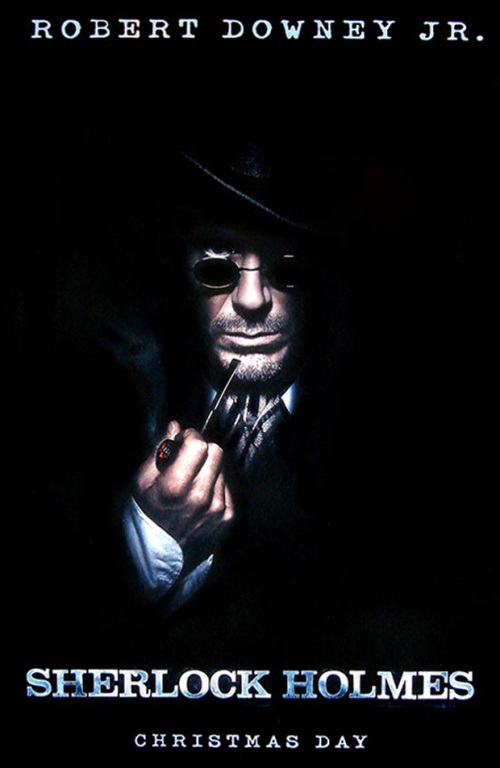
Sherlock Holmes (2009)

I loved Iron Man. Everyone loved Iron Man. So when I first saw a preview for the new Sherlock Holmes film, I thought, "Victorian Iron Man? Someone has been reading my book of dreams." This, of course, is not true as my book of dreams has long since been destroyed.

However, Sherlock Holmes is only the second film I've seen, other than Gone With The Wind, where I actually tried to fall asleep. My inability suggests more about my caffeine addiction than the viewing experience, as reading the back cover of my roommate's Iron Man DVD for an hour and a half would probably prove more exciting than watching Sherlock Holmes.

There really wasn't anything absolutely awful about the film, it's just that I had seen it already, and so have you. The movie is an explosion filled paint-by-numbers piece, which is odd since I always thought Holmes was more of a sleuthy type character. I must admit that I've never read any of Doyle's work, but I would have to assume this was nowhere near what he was writing about.

Robert Downey Jr is the one saving grace of the film, but even his performance was utterly disappointing. The man is not British, and when he fakes a British accent, half of his lines are unintelligible. The film was an attempt at the witty action film with heart (yeah, that's still you Iron Man), but fails miserably at this. The one or two laugh out loud moments are already in the previews, and the rest is just a matter of banal, CSI style crime investigation. But really, I went to this to get out of seeing Avatar, because if I'm going to be bored, I'd rather be bored for about an hour less. So I guess I can't complain.

07 December, 2009

Antichrist (2009)

Nature is Satan's church. Freud is dead. This is Antichrist, Lars von Trier's shocking horror film dedicated to the memory of Russian auteur Andrei Tarkovsky.

The film starts with a horrifically beautiful sex/death scene where the two main characters, played superbly by Willem Dafoe and Charlotte Gainsbourg engage in the sensual joys (and unlike most every film that isn't a porno, the sex scenes in Antichrist are unsimulated) while their son falls out of their apartment window. The film then follows the mother's grief while her husband, a therapist, tries to help her face her fears while keeping a clinical distance from his own wife.

The first half hour or so of the film is undoubtedly dark and depressing, illustrating the unrelenting grief felt by Gainsbourg's character, but it isn't until the couple gets to their woodland cabin, "Eden", that the film really asserts itself. Modeled after settings in Tarkovsky's autobiographic film The Mirror and his sci-fi masterpiece Stalker, Eden is the location for the films unbearably haunting second half.

I remember there being a big to-do about the graphic violence depicted in Mel Gibson's awful Passion of the Christ, but that film is tame by von Trier's standards. I'm not the kind of person that typically reacts physically to films, but in various parts of Antichrist, I came close to vomiting and crying. I spent entire scenes hiding behind my hands or staring at the wall to the left of the screen. And honestly, I kind of want to watch it again.

Asking whether or not the extreme violence and sexual content is necessary is certainly valid, and in this case, I believe that it is. I can't say I know what von Trier's intent with the film was, but if he set out to make a horror film, that's exactly what he did. I don't ever go to the theater to see horror films, but I can easily say that Antichrist is the kind of horror film that will stick with me for a long time. It isn't for the scenes of violence either, those are just garnishes to the actual horror that's happening between the two lead characters. Antichrist is little more than a remake of Bergman's Persona, drenched in blood from Willem Dafoe's penis.

My one complaint with the film was the computer graphics. I haven't seen any of von Trier's other films, so I don't know if it's typical of his work, but there was quite a bit of CGI in this film. It never looks bad, honestly, it just doesn't seem to fit in with the realism of the characters' struggles at the beginning of the movie.

I would highly recommend this film to anyone and everyone, assuming you can handle the numerous graphic scenes.