Showing posts with label Long Shot. Show all posts

16 August, 2009

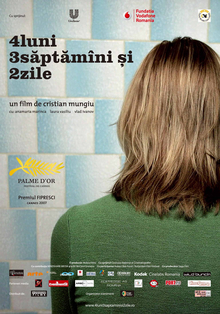
4 luni, 3 săptămâni şi 2 zile (4 Months, 3 Weeks and 2 Days) (2007)

I could simply tell you, dear reader, that 4 Months, 3 Weeks and 2 Days (winner of the prestigious Palme d'Or at Cannes in 2007) is the best film you will ever see about the subject of abortion set in communist Romania, or, I could simply tell you it's one of the best movies you will ever see.

This film is kind of like a realistic horror movie, where issues that real people might actually encounter provide the fear, as opposed to masked, chainsaw wielding camp counselors/aliens/masked, chainsaw wielding aliens. It's among the most intense films I've ever seen. What makes it so insanely nerve racking is the hyper-realistic approach the director takes in telling this story. I wouldn't say it was done in a documentary style by any means, but it was shot in a way that I haven't really seen before. Numerous scenes consist of only one or two very long takes where the characters have entire conversations, generally not relating to the story at hand, for example, a scene at a dinner table where the camera focuses in only on the main character and her boyfriend while his family is having a full conversation around them. We really get a sense of their discomfort, which quickly becomes our own. The director hasn't said that these two people are unhappy, he is showing us.

To call this simply a movie about abortion would be highly misleading. That would be like calling Let The Right One In a vampire movie. Yes, vampirism was crucial to the story, but no, that's not what that film was about. Similarly, abortion works works as a synecdoche for the oppressive constraints during Romania's time under communist rule. Evidence to the fact that abortion isn't the main issue of the film is the simple observation that the character getting the abortion isn't even the main character.

If I had to give a concise description of this film, I would describe it as a film with the beauty of the later works of Krzysztof Kieslowski with the tense horror of a Michael Haneke film. It's a horror film based entirely in reality. The superb acting and astounding camera work help make this among the best films I've seen from this entire decade (right now I'm thinking it's second only to There Will Be Blood).

06 August, 2009

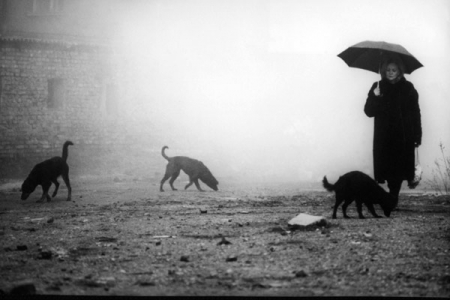
Kárhozat (Damnation) (1988)

Damnation is as well filmed a movie as I've ever seen. This is the first movie I've seen by Hungarian director Béla Tarr, and likely not the last.

The film begins with what could very well be my favorite opening shot ever, showing what appears to be a ski lift, only for the camera to very, very slowly zoom out and reveal an interior space inhabited by the films characters (having seen this a few weeks ago, I can't actually remember who shows up in the first scene, but that probably isn't important).

Not too far into the movie is a musical scene reminiscent of some of David Lynch's greatest work (think of the musical numbers in Eraserhead or Mulholland Drive); it's absolutely hypnotizing. I remember thinking while watching, I hope this song never ends.

That, in itself, is an apt description of the film. It's pace, which may be considered slow by a snail with a limp, helps provide a mesmerizing feeling. I got completely lost in this film, at certain points I completely forgot that I was even watching a movie.

The story in Damnation is pretty minimal. The protagonist struggles with sanity as he tries to rekindle a past romance with an unwilling female, portrayed here rather hauntingly. The protagonist finds a way to get the woman's husband to leave town as he makes attempts to reconnect with her, and the film progresses from there to the final, depressing outcome.

This movie may require a bit of patience for most viewers. It's not too long of a movie, but it certainly doesn't fly by. Certainly a movie I need to see again, and one you should see for the first time, dear reader (assuming you exist)!

Русский ковчег (Russian Ark) (2002)


Rarely have I ever been so unsure of what to think of a movie as I have with this. I just finished watching it, and I'll likely have to force myself to watch it again before making any final decisions.

Russian Ark, if nothing else, is a technical masterpiece of cinema. The film consists of one shot lasting more than an hour and a half, with a cast of thousands. The entire film is shot in a St. Petersburg museum (formerly the czar's winter palace). The movie serves largely as a museum tour, as well as a tour through a few centuries of Russian history.

Unfortunately, my knowledge of Russian history is limited primarily to the 20th century, and even there it's iffy. While I had no clue what the characters were discussing for most of the film, it's still a wonder to watch. There is a definite dream-like quality to the work.

There really is no plot to speak of. The narrative structure of the film begins with a narrator discussing an accident, and suddenly we are transported to Russia where 19th century party guests arrive at the museum. The camera serves as the eyes of the narrator, who is only seen by another mysterious traveler, an Italian, who in various scenes goes as unnoticed as the narrator.

The two travel through the museum, each room is a different, non-chronologically ordered period of Russian history. They discuss the Russian people, art, music and politics. All the while, the Italian lumbers about in the creepiest way possible, cornering helpless museum visitors and discussing Christianity with them.

The final "scene" is a magnificently filmed ballroom scene and a long procession down some lovely staircases and hallways with literally hundreds of extras all around. Again, this film is an absolute wonder to witness. I was nervous every time the cameraman had to go up and down stairs, with an irrational fear that he may trip at some point.

As a whole, I think I can safely recommend this film not just simply for its technical genius. It does move quite slowly at times; a great many scenes in the middle of the film consist largely of discussing certain aspects of paintings and who purchased them from who, but there is definitely enough interest to make you want to watch it until the end. Maybe after watching this I'll have the ambition to attempt to watch Bela Tarr's 7+ hour Sátántangó, which, according to Wikipedia, contains only around 150 shots for the entire work. Attempt is the key word there.