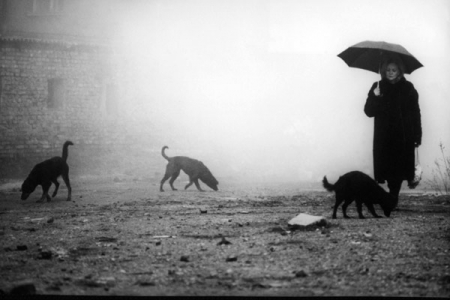
I don't want to stress the length of Satantango too much in this review, so I think I'll just get it out of the way to begin with: 450 minutes . I'm unfortunately a bit impatient with movies, which surprises people a lot, so I had to split my viewing into three days, a day for each disk of the film. This undoubtedly takes away from the experience; Bela Tarr's films aren't so much about story as they are about mood. However, he is peerless when it comes to transporting the viewer to a different place, so it's almost eerie how I got sucked in after taking a day or two in between disks without missing a beat.
The basic plot of Satantango follows the arrival of a charismatic local who was previously believed to have died during an unnamed war that's pressing closer to the small, rural town. He convinces the farmers to create an agricultural society in exchange for their yearly wages. That's really the meat of the story. Like I said, Tarr's films aren't ever that focused on plot.
Tarr's moods are heart-breakingly entrancing. In more than one instance, the camera follows characters walking for what must be at least 5 minutes without any cutting. Tarr works only in long shots. Supposedly, there are a grand total of 150 shots in the entire film. That means an average shot length of 3 minutes, in case you were wondering but too lazy to calculate.
I find it interesting to compare Tarr's style with that of Gus van Sant, who's film Elephant also featured a number of lengthy shots of characters walking. However, where Tarr's scenes actually add to the atmosphere of the film, van Sant's serve only to remind us of how bland high school hallways are (I really, really hate Elephant. It's currently tied with Reservoir Dogs on my list of movies I never, ever want to see again).
The film is divided into a number of different sections, each focusing predominantly on a single character. Like Reservoir Dogs, the viewer sees the same actions happen numerous times from different perspectives, but unlike Tarantino's film, these scenes don't do much for the plot, they just strengthen the characters by adding significant amounts of depth. I'll admit that I'm entirely biased and think that Tarantino is incapable of making a good film, so I should probably stop using him as an example to explain movies I like.
In these character vignettes, all the motives and actions of the characters are explained and examined. No character is quite as interesting as the doctor, who writes down the activities of the locals in small notebooks. The doctor is morbidly obese, making it ironic that the only character capable of observing life is the most incapable of actually living it.
Satantango is undoubtedly the most complex film I've seen since Inland Empire. Tarr does a very good job mixing a sense of humor that's darker than a moonless midnight with scenes that will actually make you feel really, really uncomfortable. No scene accomplishes this more than one chapter (Those Coming Unstitched, I believe). For about 20 minutes, the viewer is subjected to a hooker's daughter forcing her pet cat to bend to her will, having nothing else that she can physically dominate in her environment. If Tarr hasn't received any PETA death threats for this scene, I'd be amazed. With that said, I'm not sure there's any better filmed segments in the entire film.
I'm sure the length of the film will turn off most viewers, but I must assure anyone interested that the film doesn't drag (unless you simply cannot stand his ultra-slow style of filmmaking). I can remember a grand total of 3 shots in the entire film that I feel should have been shortened or omitted. Even with heavy editing, I can't imagine making this film under 6 and a half hours long.
As a final statement, I have to admit that despite its lofty ambitions, its flawless presentation and its incredible atmosphere, I would recommend his follow up film Werckmeister Harmonies over Satantango. Two great films, but Werckmeister just has something special that I can't figure out (it might be a rotting whale corpse).