15 January, 2010

Festen (The Celebration) (1998)

In 1995, Thomas Vinterberg and Lars von Trier released the Dogme 95 manifesto into the cinema world by means of flyers thrown at a Parisian audience during a talk von Trier was giving to commemorate the first century of film history. The most prominent feature of the manifesto (one of many that von Trier has written) is the "Vow of Chastity", which is a sort of 10 commandments for film. The list is simply ridiculous, with rules like cameras must be handheld (preferably digital), all music must be recorded live, no props are allowed unless they are found on the site, everything must be filmed on site, and greatest of all, the director can never be credited.

In 1998, Dogme #1 was released, Thomas Vinterberg's The Celebration. Dogme actually had a board certify the films, which can be found in numeric order on their website (though the group has since disbanded).

The Vow was intended to reintroduce the element of realism into film (assuming it wasn't simply an elaborate prank being played by von Trier and co, seeing as how many of the Dogme founders never directed more than one Dogme film). However, it simply works as a stylistic guide for a specific aesthetic. Were the Dogme filmmakers really concerned with the lack of realism in Hollywood movies, the omission of any rules related to editing seem to negate any attempted realism (jump cuts aplenty!).

With all of that said, Vinterberg's debut feature is an absolute gem. Winner of the Jury prize at Cannes that year, Festen was justly praised on its release. No matter how gimmicky the Dogme "movement" was, films like this almost justify its extravagant scope (I'm sure there are plenty of Dogme duds, but so far, I've seen 3 and loved them all).

As for the film itself, I think it might just be one of the most depressing pieces put to film. The movie is about a family and their friends gathered for the 60th birthday of their patriarch. Like all Danish families, no doubt, this one has an unbearably dark past. Just minutes into the film, we discover that the father's grown children, spread out in various walks of life, are recently recovering from the death of a sister. Her twin seems the most rattled, while the youngest brother apparently didn't even attend the funeral. Domestic squabbles and family revelations abound in this film.

The setup of the film reminds me very much of France's golden cinema cow, Jean Renoir's La Règle du jeu, a film whose reputation I've never quite agreed with, but is a worthwhile watch anyway. Basically, there is a house full of people who have unknowingly agreed to enjoy themselves no matter what, and one rebel who is out to reveal the demon in the crowd.

What makes Festen so successful is a few things. One is the stylized look, naturally. What would become trite in just a few years was new and fascinating at this point. Secondly, the utterly fantastic characters, who are more well rounded, flawed, tragic than any film I can recall. Finally, the unrestrained content of the film is really shocking. The issues discussed in this movie (which I will not speak too much of, I would much rather you see the film for yourself, and say "Oh my god!" just as I did) are simply not addressed in films, and I really wonder why.

What really shocked me about the movie, other than the family secrets being revealed, was the very subtle humor. While I would gladly describe the movie as utterly depressing, it definitely doesn't go without taking a few jabs here and there, and by the end, you kind of hate Danish people. Well, more than you already, naturally do.

12 January, 2010

The Imaginarium Of Doctor Parnassus (2009)

Terry Gilliam makes a movie with "Imaginarium" in the title and casts Tom Waits as the devil. This sounds as close to a slam dunk as a movie can be. Unfortunately, Parnassus is more of a shot clock violation. The ideas get passed around so much that Gilliam forgets to take a shot.

There is a lot to like in Gilliam's newest film, from the exquisite cast (minus Verne Troyer, who delivers his witty lines like a particularly bland board), to the premise of the film, which involves an immortal monk making wagers with Mr. Nick/Satan to protect his family, while the rest of the cast gets to spend a lot of their time inside a fantasy land.

However, the fantastic elements just aren't that imaginative. Maybe it was just CGI overkill, but I found the film to be at it's least interesting in the dream-like imaginarium, which should really be Gilliam's strength. And as dull as I found Avatar, that technology showcase masquerading as a narrative, actors submersed in CGI landscapes in any other movie just looks silly in comparison. Watching this after watching James Cameron's film, which undoubtedly cost the GDP of various small countries was like watching Jurassic Park on TV. Had this film not relied so heavily on these technical elements, it could have been much stronger, but instead gets handicapped by its already dated appearance.

I would consider myself a fan of Gilliam's work. Brazil is one of my absolute favorite films (watch for Brazil lead Jonathan Pryce to make a brief cameo during Parnassus). It's a well established fact that Gilliam knows his way around an imagination as only someone like Tim Burton could hope for (the jury is still out on whether Gilliam or Burton will make Johnny Depp: The Movie first). But Parnassus seems more like the uninspired work of latter day Burton than Gilliam, minus the fact that it's not a remake (not that Gilliam has been at the top of his game lately, and I'll admit to greatly enjoying Sweeney Todd).

All in all, Parnassus is a surprisingly tight narrative, with generally good acting, but it just never really becomes anything great. It's not Gilliam's worst film, but it's far from his best. I think of this more as a step in the right direction than a great movie. Gilliam is indeed returning to the silliness and imagination of his older movies, it's just a matter of quality that's the issue.

29 December, 2009

Avatar (2009)

Stock characters, heavy handed political messages, and ghastly production costs. This is indeed a James Cameron film. I will admit that I genuinely think Titanic was a piece of filmmaking brilliance, and Aliens was pretty good as well, but for me, Cameron's ability to make an interesting movie ends there.

Avatar is essentially Last of the Mohicans, Fern Gully and She's All That, made in Three Dimensions(!!!!). As a technical piece, it is unmatched in its visual spectacle. The movie just looks absurdly good. It's genuinely unsettling how detailed everything about the movie is.

At least everything about the movie that doesn't relate to characters or story. Other than the final battle scene, and just the general look of the film, there is really no redeeming quality to the movie.

The characters are characters you've seen from the last action movie you saw. They deliver the lines they are supposed to and either succeed or die in the end, though it's clear who does what. I cringed when the main character had to give his heart to heart to his lady interest that it only started out as a job, but he really was in love, with all the syrupy Freddie Prince Jr. sweetness he could muster.

I can't say I wouldn't recommend this movie, because it was a treat for my eyes. But paying $10 or whatever IMAX is charging to see it only encourages directors to keep producing these kinds of dull experiments in spending as much money as possible. And seeing as I paid to see this and Transformers II this year, I have more than done my part to make this world a slightly worse place, and for that, I apologize.

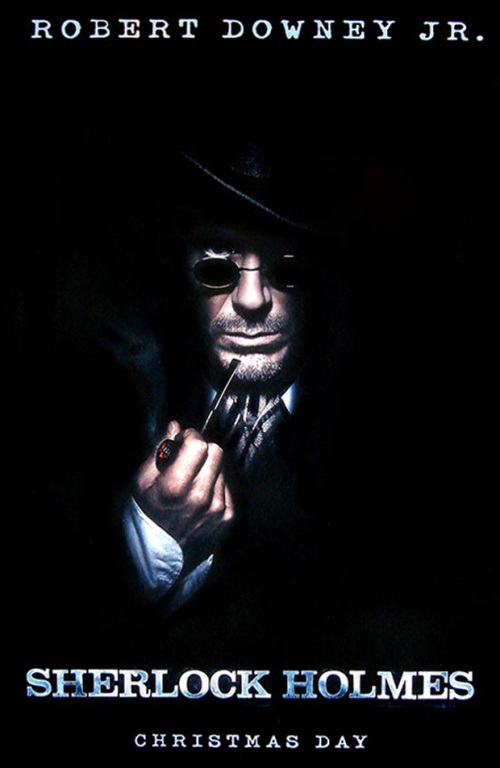
Sherlock Holmes (2009)

I loved Iron Man. Everyone loved Iron Man. So when I first saw a preview for the new Sherlock Holmes film, I thought, "Victorian Iron Man? Someone has been reading my book of dreams." This, of course, is not true as my book of dreams has long since been destroyed.

However, Sherlock Holmes is only the second film I've seen, other than Gone With The Wind, where I actually tried to fall asleep. My inability suggests more about my caffeine addiction than the viewing experience, as reading the back cover of my roommate's Iron Man DVD for an hour and a half would probably prove more exciting than watching Sherlock Holmes.

There really wasn't anything absolutely awful about the film, it's just that I had seen it already, and so have you. The movie is an explosion filled paint-by-numbers piece, which is odd since I always thought Holmes was more of a sleuthy type character. I must admit that I've never read any of Doyle's work, but I would have to assume this was nowhere near what he was writing about.

Robert Downey Jr is the one saving grace of the film, but even his performance was utterly disappointing. The man is not British, and when he fakes a British accent, half of his lines are unintelligible. The film was an attempt at the witty action film with heart (yeah, that's still you Iron Man), but fails miserably at this. The one or two laugh out loud moments are already in the previews, and the rest is just a matter of banal, CSI style crime investigation. But really, I went to this to get out of seeing Avatar, because if I'm going to be bored, I'd rather be bored for about an hour less. So I guess I can't complain.

07 December, 2009

Antichrist (2009)

Nature is Satan's church. Freud is dead. This is Antichrist, Lars von Trier's shocking horror film dedicated to the memory of Russian auteur Andrei Tarkovsky.

The film starts with a horrifically beautiful sex/death scene where the two main characters, played superbly by Willem Dafoe and Charlotte Gainsbourg engage in the sensual joys (and unlike most every film that isn't a porno, the sex scenes in Antichrist are unsimulated) while their son falls out of their apartment window. The film then follows the mother's grief while her husband, a therapist, tries to help her face her fears while keeping a clinical distance from his own wife.

The first half hour or so of the film is undoubtedly dark and depressing, illustrating the unrelenting grief felt by Gainsbourg's character, but it isn't until the couple gets to their woodland cabin, "Eden", that the film really asserts itself. Modeled after settings in Tarkovsky's autobiographic film The Mirror and his sci-fi masterpiece Stalker, Eden is the location for the films unbearably haunting second half.

I remember there being a big to-do about the graphic violence depicted in Mel Gibson's awful Passion of the Christ, but that film is tame by von Trier's standards. I'm not the kind of person that typically reacts physically to films, but in various parts of Antichrist, I came close to vomiting and crying. I spent entire scenes hiding behind my hands or staring at the wall to the left of the screen. And honestly, I kind of want to watch it again.

Asking whether or not the extreme violence and sexual content is necessary is certainly valid, and in this case, I believe that it is. I can't say I know what von Trier's intent with the film was, but if he set out to make a horror film, that's exactly what he did. I don't ever go to the theater to see horror films, but I can easily say that Antichrist is the kind of horror film that will stick with me for a long time. It isn't for the scenes of violence either, those are just garnishes to the actual horror that's happening between the two lead characters. Antichrist is little more than a remake of Bergman's Persona, drenched in blood from Willem Dafoe's penis.

My one complaint with the film was the computer graphics. I haven't seen any of von Trier's other films, so I don't know if it's typical of his work, but there was quite a bit of CGI in this film. It never looks bad, honestly, it just doesn't seem to fit in with the realism of the characters' struggles at the beginning of the movie.

I would highly recommend this film to anyone and everyone, assuming you can handle the numerous graphic scenes.

08 November, 2009

Once (2006)

I like Nick Cave a lot. In the last few months, The Bad Seeds have been in my CD player more than any other band, simply because their music is really, really good. I would consider myself a fan of Nick Cave, absolutely. However, I would never think to make a film based mostly on his music. Even if I introduce a few characters (perhaps a charming female lead?), the story would still undoubtedly be lacking, and the quality of the film would depend entirely on how much the viewer likes Nick Cave's music. Using his music for emphasis would be fine (Wings of Desire now available on Blu Ray!), but as a central theme? No thank you.

It is for this reason that beloved indie musical Once is pretty terrible. Take one part street crooner, one part attractive street vendor, add some agreeable, though otherwise unremarkable tunes, and you have a movie about a street crooner, an attractive street vendor and some agreeable, though otherwise unremarkable tunes.

The main character of the film is really the music. Like I said already, the music is far from bad, I might even listen to the soundtrack once in a while if I had it. But I'm not so enraptured by it that I would ever want to see a movie about it. The scenes in the film are really just written around the music, finding ways to allow the flat personalities to interact. Through song.

To its credit, Once is delightfully unpretentious. I don't think I've ever seen a movie so ready to present itself so matter-of-fact, just kind of hoping people would like it, without really expecting much from the audience. At the same time, I think a little pretension is needed. It's a film after all, trying to pretend the camera and crew aren't there and the film is merely happening is as hokey as an Ansel Adams photograph (note: Ansel Adams is just about the greatest photographer ever, but goddamn are his pictures painfully romanticized). Unlike another recent, awful musical, Across The Universe, Once really has nothing going for it outside the music. At least that film had a few neat music videos hidden among 2 hours of poor film-making. Once, on the other hand, feels as though it wasn't even directed, but merely occurred and was documented.

Also, the movie has a really dumb poster.

02 November, 2009

Satantango (1994)

I don't want to stress the length of Satantango too much in this review, so I think I'll just get it out of the way to begin with: 450 minutes . I'm unfortunately a bit impatient with movies, which surprises people a lot, so I had to split my viewing into three days, a day for each disk of the film. This undoubtedly takes away from the experience; Bela Tarr's films aren't so much about story as they are about mood. However, he is peerless when it comes to transporting the viewer to a different place, so it's almost eerie how I got sucked in after taking a day or two in between disks without missing a beat.

The basic plot of Satantango follows the arrival of a charismatic local who was previously believed to have died during an unnamed war that's pressing closer to the small, rural town. He convinces the farmers to create an agricultural society in exchange for their yearly wages. That's really the meat of the story. Like I said, Tarr's films aren't ever that focused on plot.

Tarr's moods are heart-breakingly entrancing. In more than one instance, the camera follows characters walking for what must be at least 5 minutes without any cutting. Tarr works only in long shots. Supposedly, there are a grand total of 150 shots in the entire film. That means an average shot length of 3 minutes, in case you were wondering but too lazy to calculate.

I find it interesting to compare Tarr's style with that of Gus van Sant, who's film Elephant also featured a number of lengthy shots of characters walking. However, where Tarr's scenes actually add to the atmosphere of the film, van Sant's serve only to remind us of how bland high school hallways are (I really, really hate Elephant. It's currently tied with Reservoir Dogs on my list of movies I never, ever want to see again).

The film is divided into a number of different sections, each focusing predominantly on a single character. Like Reservoir Dogs, the viewer sees the same actions happen numerous times from different perspectives, but unlike Tarantino's film, these scenes don't do much for the plot, they just strengthen the characters by adding significant amounts of depth. I'll admit that I'm entirely biased and think that Tarantino is incapable of making a good film, so I should probably stop using him as an example to explain movies I like.

In these character vignettes, all the motives and actions of the characters are explained and examined. No character is quite as interesting as the doctor, who writes down the activities of the locals in small notebooks. The doctor is morbidly obese, making it ironic that the only character capable of observing life is the most incapable of actually living it.

Satantango is undoubtedly the most complex film I've seen since Inland Empire. Tarr does a very good job mixing a sense of humor that's darker than a moonless midnight with scenes that will actually make you feel really, really uncomfortable. No scene accomplishes this more than one chapter (Those Coming Unstitched, I believe). For about 20 minutes, the viewer is subjected to a hooker's daughter forcing her pet cat to bend to her will, having nothing else that she can physically dominate in her environment. If Tarr hasn't received any PETA death threats for this scene, I'd be amazed. With that said, I'm not sure there's any better filmed segments in the entire film.

I'm sure the length of the film will turn off most viewers, but I must assure anyone interested that the film doesn't drag (unless you simply cannot stand his ultra-slow style of filmmaking). I can remember a grand total of 3 shots in the entire film that I feel should have been shortened or omitted. Even with heavy editing, I can't imagine making this film under 6 and a half hours long.

As a final statement, I have to admit that despite its lofty ambitions, its flawless presentation and its incredible atmosphere, I would recommend his follow up film Werckmeister Harmonies over Satantango. Two great films, but Werckmeister just has something special that I can't figure out (it might be a rotting whale corpse).