10 September, 2009

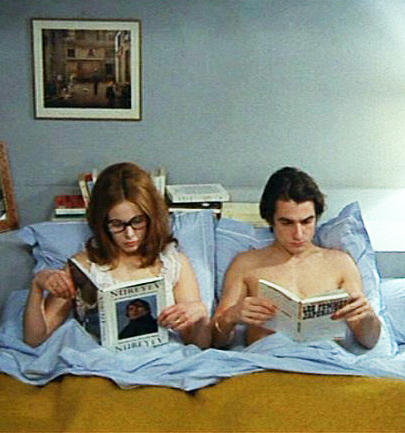
Antoine Doinel (1959, 1968, 1970, 1979)

Francois Truffaut helped spark one of cinemas greatest movements in 1959 with the release of Les quatre cents coups (The 400 Blows), heralding the start of the French New Wave. A semi-autobiographical tale, The 400 Blows tells the story of 12 year old Antoine Doinel, a trouble making preteen who runs amok in Paris. Not intended as the beginning of a series, The 400 Blows eventually sparked 3 feature length sequels, and one short film. Enough has undoubtedly been said about The 400 Blows, astoundingly good for being Truffaut's debut feature (though arguably topped by his colleague and friend, Jean-Luc Godard the next year with the release of A bout de souffle). However, for those new to the film (as I was just a few months back), it's absolutely require viewing for anyone interested in world cinema.

Starting with Baisers voles (Stolen Kisses) in 1968, the second feature length and third overall film in the series, Truffaut expanded upon Doinel's character, giving more control to the unbelievably charismatic lead, Jean-Pierre Leaud. Whereas The 400 Blows was fairly serious, Stolen Kisses is really, really funny. While 400 is undoubtedly the masterpiece of the series (and one of the greatest films ever, really), I actually prefer the later, lighter films. Leaud's comic acting is undoubtedly the cause of this.

Stolen Kisses, Domicile conjugal (Bed and Board) (1970), and L'amour en fuite (Love on the Run) (1979) shift the focus from the childhood rebellion of The 400 Blows to telling of Antoine's various love affairs throughout his life and his bizarre, constantly changing occupations. The real treat of the series is the cast, which stays the same for every movie. By Love on the Run, Leaud is 20 years older than he was during the filming of The 400 Blows. The viewer really gets to see the actors growing up, which is delightful. Unfortunately, Truffaut noticed this too, and made Love on the Run into a scrapbook of memories rather than a movie. About half of the film is flashbacks, which means scenes from other films in the series. This could be done interesting and well, but as even Truffaut would admit, he failed in this regard. Still, the material that is new is just as good as the previous films.

I think the Antoine Doinel series, available as a box set from Criterion, has to be my favorite film series. Truffaut's scripts are phenomenal, from the scenes of a family struggling to stay together in The 400 Blows to the scenes of Antoine bouncing around from job to job in the later films. The real treat has to be Leaud's acting, which was also put to good measure in a number of Godard's films. I can't tell if he's a great actor or just plays characters close to his own personality, but he's a lot of fun to watch. I would probably recommend The 400 Blows only to people interested in foreign classics, but I can't imagine many people disliking Stolen Kisses or Bed and Board.

Uzak (Distant) (2002)


As an aspiring filmmaker that lacks any especially spectacular ideas for films, movies like the Turkish Uzak are inspirational. To put it simply, Uzak is just about people being people. Granted, these people are painfully lonely, but no scene in the film feels out of place from a normal day. This is the least cinematic film I've ever seen.

By no means am I suggesting that it's bad. In fact, I think Uzak will make my eventual list of the best films I've seen from this century. However, the subject matter is wonderfully banal. It was filmed exquisitely, and is one of the more beautiful films I've seen in a while. By calling it uncinematic, I simply mean that nothing in the movie seems to fit the usual mold of what people make movies about.

The movie follows to characters in Istanbul, one an established photographer in the town, the other a friend from a village coming to find work. Long scenes show the two characters watching TV, eating alone at a restaurant or simply walking around snowy Istanbul. Their solitary existence is all too easy to relate to (though the shots of the characters walking through parks and only seeing happy couples at play was a bit heavy-handed). Granted, they are fond of following attractive women around, but minus their occasional creepy habits, the characters seem like people you probably know, or even people who write rarely read movie review blogs.

Like a number of movies I've written about, I can safely say that this is not a film for everybody. Nothing really happens. Not to say there is no story, but to reiterate, the film is uncinematic and there are no twists, no major plot points, nothing common place in most films. This feels almost like the work of a director unfamiliar with movies. Rather than making a movie about movies, as most movies seem to be, Uzak is really a portrayal of the actual banality of existence.

21 August, 2009

Revolutionary Road (2008)

Some months ago, a friend and I headed to the theater to go see Revolutionary Road. I can't remember why exactly, but we somehow showed up about half an hour late to the theater, and instead settled on the utterly mindless Underworld prequel (never mind the fact that I hated the first one). Having come at a stressful week in school, this was a welcome vacation for my brain. Very few things require less thought than a movie made by a former special effects coordinator about a war between vampires and werewolves, even if the main werewolf had just recently been absolutely amazing in the movie that probably should have won best picture at last year's Oscars, Frost/Nixon.

Fast forward a few months, and I'm sad to report, that delay in arriving to the theater was something of a blessing. I'm sure if I was some sort of movie journalist, I would lose my job for saying this, but Underworld was monumentally better than Revolutionary Road.

I simply cannot understand A) how this movie got good reviews, and B) how Kate Winslet won any awards for her performance. She's one of my favorite actors currently working (as evidenced by the giant Eternal Sunshine poster of her face on my wall), but she, as well as DiCaprio, do a lot more play acting than film acting. None of their movements, none of their lines, none of their interactions look like anything two people would actually ever do. They look like they are acting; the movie feels too much like its a movie. The acting is very, very stiff (when the two leads aren't overacting), and the dialog is often perplexingly bad (for example, during an argument on the beach, DiCaprio ends it by taking off his shirt saying something to the effect of "It's too hot for this, I need to get wet").

Mediocre performances aside (I still cannot wrap my head around how Winslet got nominated and won awards, I just can't do it), director Sam Mendes ruins what I assume is a pretty good novel. The film basically tells the story of a couple achieving the American dream and discovering that the status quo isn't actually fulfilling, as their marriage quickly falls to pieces. Where there any other revelations or themes anywhere in the entire movie, maybe this film would have a chance to be something special. But no, Mendes lingers on the one, earth-shattering realization that living in the suburbs isn't the dream everyone is chasing. I'm 21, never been anywhere close to marriage, and these ideas seem all too obvious to me, yet Mendes presents them as though the audience would never have considered them before.

And that makes me wonder, are the people watching Revolutionary Road as slow to understanding as the characters? I think Mendes' intention was to be, well revolutionary, and shake up a few minds to realize that maybe they aren't living the way they want to live. But if they need a movie to point this out to them, a shallow, dull movie, I suppose they deserve their shallow, dull lives (I however, quite like my shallow, dull life, and wouldn't trade it for the world).

Sånger Från Andra Våningen (Songs From The Second Floor) (2000)

It's safe to say I have a thing for Swedish films. I assume this is only because Norway's cinema doesn't have the same worldwide renown (though I am eagerly awaiting O'Horten to finally come to a goddamn theater near me). There's just something about really cold people in films that really speaks to me, apparently (this might explain why I also like Canadian Bacon). But I think Sweden is special. Like France, which just has that unique, French quality, Swedish films seem to thrive by being so Swedish.

Songs From The Second Floor is very Swedish. The movie moves at the current walking speed of Ingmar Bergman (hint: he's been dead for 2 years), I don't think there is a single camera movement in the entire film, and everything about it is bleak. It's also remarkably funny. I'm not sure I would go so far as to call this movie a black comedy, but I think that would be a fairly good description.

The movie is something of a modern dystopia. The economic scene in Sweden is less than favorable and everyone is trying to leave the unnamed location of the film without any explanation.

What really makes this movie special is the complete surreal world director Roy Andersson creates. The sets look real enough that you could not notice how much of the film was shot in studios (I'm guessing almost all of it), yet the backgrounds also look like muted stock from Edward Hopper paintings. This film really brings to mind the outrageous spirit of Spanish auteur Luis Bunuel, with a reserved Swedish delivery. Additionally, these sets are supported by the bizarre happenings of the film, which range from an unexplained fire to a human sacrifice, all within an enclosed, corporate world.

Definitely not a movie for the impatient viewer, Songs presents a lot of potential frustration if not seen in the right mood. The humor is delivered in deadpan stares, similar to a Wes Anderson or Jim Jarmusch affair. To give you an idea of possible reactions to this film, I heard of it when two classmates were discussing it in my Norwegian class, having seen it in their Scandinavian film class. One student asked the other "You actually liked that movie?" Similarly, while I laughed quite loud throughout quite a bit of the movie, my mother who was watching with me, fell asleep a number of times during the films duration. It's one of the few movies I've seen recently that I was sad to see end, but for some, I'm sure the hour and a half run time seems closer to an eternity.

Adam (2009)

I remember seeing a trailer for Lars and the Real Girl a few years back and thinking, "that looks fantastically bad", though I had a secret hope that it would somehow be excellent. I was eventually talked into seeing it, and truth be told, I nearly cried during it. It's an absolutely phenomenal film about a guy who just doesn't understand human interaction. As someone with some anxiety issues, I can certainly relate, though not on the same scale of course, and I felt quite touched by the inevitable happy ending. When I read the synopsis of Adam, Max Mayer's second film according to imdb, I thought to myself "this looks like Lars with Aspergers".

And it was. Just not as good. Adam has Aspergers. Adam also has a gorgeous neighbor (Rose Byrne), who wants to help him like the pilot helps the Little Prince in the fantastic story of the same name, as mentioned in the opening narration. Unfortunately for Adam, he's stuck both in his head and in a formulaic romantic comedy (amusingly, Hugh Dancy, the lead actor, didn't realize this until late in the shooting).

As a result, you know when you sit down what is going to happen. You know that Byrne's character is going to fall for Adam's quirks, and you know when Adam just isn't going to understand the situation and fly off the handle. You know how the film ends already (well, you can narrow it down to a few possible choices). With all that said, I enjoyed Adam.

Similar to a movie like Once, Adam is joyfully unpretentious. Unlike Once, there is actually some content to the movie to make it worth watching other than the delightful leads. Also unlike Once, I would actually recommend this movie to other people. The central issues of the film seem important to the director, and his sincerity more than makes up for the shortcomings of the production. And even when some holes are too big to be covered up, there are absolutely fantastic performances on display by the two leads, as well as Adam's lone friend and the films main source of humor, Harlan.

I would ultimately say that this isn't a film that really needs to be seen in theaters. Just wait a few months for it to be a 99 cent rental at Blockbuster, and enjoy it for its successes. Ideally though, you could just rent Lars and the Real Girl instead.

16 August, 2009

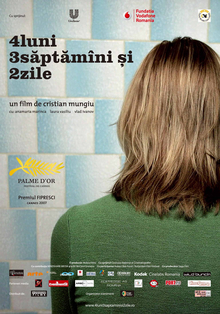
4 luni, 3 săptămâni şi 2 zile (4 Months, 3 Weeks and 2 Days) (2007)

I could simply tell you, dear reader, that 4 Months, 3 Weeks and 2 Days (winner of the prestigious Palme d'Or at Cannes in 2007) is the best film you will ever see about the subject of abortion set in communist Romania, or, I could simply tell you it's one of the best movies you will ever see.

This film is kind of like a realistic horror movie, where issues that real people might actually encounter provide the fear, as opposed to masked, chainsaw wielding camp counselors/aliens/masked, chainsaw wielding aliens. It's among the most intense films I've ever seen. What makes it so insanely nerve racking is the hyper-realistic approach the director takes in telling this story. I wouldn't say it was done in a documentary style by any means, but it was shot in a way that I haven't really seen before. Numerous scenes consist of only one or two very long takes where the characters have entire conversations, generally not relating to the story at hand, for example, a scene at a dinner table where the camera focuses in only on the main character and her boyfriend while his family is having a full conversation around them. We really get a sense of their discomfort, which quickly becomes our own. The director hasn't said that these two people are unhappy, he is showing us.

To call this simply a movie about abortion would be highly misleading. That would be like calling Let The Right One In a vampire movie. Yes, vampirism was crucial to the story, but no, that's not what that film was about. Similarly, abortion works works as a synecdoche for the oppressive constraints during Romania's time under communist rule. Evidence to the fact that abortion isn't the main issue of the film is the simple observation that the character getting the abortion isn't even the main character.

If I had to give a concise description of this film, I would describe it as a film with the beauty of the later works of Krzysztof Kieslowski with the tense horror of a Michael Haneke film. It's a horror film based entirely in reality. The superb acting and astounding camera work help make this among the best films I've seen from this entire decade (right now I'm thinking it's second only to There Will Be Blood).

Hannah And Her Sisters (1986)

I rented this knowing very little about it, other than it was a Woody Allen movie that had been nominated for Best Picture. Knowing that it was one of Woody Allen's good movies was enough to make me want to watch it, but I had expected it to be something of a comedy. It definitely has its laugh out loud moments, but to my surprise, it is so much more than that. I am tempted to call this my favorite Woody Allen film, though it would definitely be hard to put it over Manhattan, which is damn near perfect.

What this film has that I don't see in Annie Hall or Manhattan is maturity. Those movies are a little bit more about middle-age relationships, while Hannah deals almost exclusively with marriage and family. Also, this film has one thing that no other Woody Allen film has, Max von Sydow.

Allen casts Sydow as a brooding, misanthropic artist. It's a fairly minor role, but it's one of a number of great performances that make the film excellent beyond its already wonderful script. Michael Caine really steals the movie as the alduterous husband of Hannah, played touchingly by Mia Farrow. Woody Allen also turns in a good performance as a TV writer struggling with the possibility of death.

His existential crisis plays alongside Caine's regret and infidelity, similarly to the structure of one of Allen's other great films Crimes and Misdemeanors, where Allen, a documentary director questioning his integrity as an artist, has his story compared with the much darker story of a man driven to murder. I was at a baseball game tonight thinking about the final scene of that movie, and I felt absolutely crushed (but not for too long, as the Diamondbacks were about to beat the Dodgers).

Allen's character is largely superfluous, but adds themes and tangents that the film would be missing without it. His part in the movie is almost like Woody Allen deciding to direct his own Seventh Seal, playing out his fear of death on the screen just as Bergman did in his classic film (that would make sense as to why this of all his films, was the one that he cast von Sydow).

The more I think about it, the more I consider it among the best films I've ever seen. I would definitely need to see it again before being too sure about my thoughts on it, but it is absolutely a must see for fans of Woody Allen, or just anyone looking for a good movie. And if nothing else, you'll do a double take the first time you realize that Carrie Fisher actually exists outside of Star Wars.