20 April, 2010

Reassessing Lars von Trier

I hope to include more posts about film in general in the future, and not simply limit my writing to reviews. So to begin, I'll cover my current obsession, the films of Lars von Trier.

My introduction to von Trier's work, as mentioned in an earlier post, was with the 2009 art-house horror film Antichrist. I just watched it for the second time, and I'm still convinced that it's an absolute masterpiece. Since initially seeing that film last December, I've seen an additional 4-5 of his films and recently read a biography focusing on his films. I feel I have a much greater understanding not only of his career in general, but specifically Antichrist, which I would undoubtedly place amongst my favorite films.

When I first watched Antichrist, my main complaint was the use of CGI. After the second viewing, this issue didn't bother me so much. Unlike most directors, von Trier really does use CGI as a story-telling tool, not simply something nice to look at (on that note, I'm intrigued by the recent news that Wim Wenders and Werner Herzog will be filming documentaries in 3D, though not necessarily excited). Sure, the fox grunting "Chaos reigns" is over the top, but in the context of the film, it's rather unsettling. And this is the crux of my complaint against Antichrist, the scenes that unsettle create more terror than the scenes that shock.

There are 3 instances of true horror for me in the film, and none of them feature the graphic violence the film is notorious for sporting. In one scene, "He" (Willem Dafoe) is flipping through "She's" (Charlotte Gainsbourg, whose album IRM, which was inspired by her experience on this film is well worth checking out) thesis work, titled "Gynocide". The camera shows the pages as he flips through, with the handwriting descending quickly into unintelligible scribbles by the end of the book.

This scene is genuinely terrifying, and I think nullifies any claim of misogyny brought against von Trier for this particular film (his "Golden Heart" trilogy on the other hand may be harder to defend, a set of films in which horrible things happen to women for no apparent reason). Gainsbourg's character proves in multiple instances that she is not mentally stable, so any claims she makes shouldn't be read outside the context of insanity ("A crying woman is a scheming woman", for example). Von Trier undoubtedly erred (or rather, provoked) in granting the character only the designation of "She", placing her as both Eve and Cain by housing her in Eden.

To return to my complaint, the film excels as an uncomfortable psychological horror film. I think I initially thought of it as Persona meets Saw, and it's really just a distinct break between the two, not so much a streamlined convergence. The Bergmanesque power struggle, as one reviewer designated it, really carries the film for me. I can even buy the supernatural elements of the film, embrace them even. But up until the fourth chapter of the film, "The Three Beggars", Antichrist is a fascinating film about coping with grief (and pain and despair) in all the wrong ways.

After the now infamous fox warns "He" of what is currently reigning, the film descends into the model of a more typical horror film. But this isn't to suggest the film falters in this regard. I think von Trier would have done better to avoid the explicit, limit his terror to the subtle scenes and revelations that can get under a viewers skin (Dafoe's realization that "There is no such constellation" is ultimately more unsettling than 1000 bloody ejaculations, much less one). But he doesn't, and as a result, I had to stare at the ceiling for parts of my initial viewing in order to not vomit (snip snip).

So where does a film like this fit in with the rest of his work? I'll admit that I haven't seen some of the more important works of his career, such as the second half of his breakthrough film Breaking The Waves, his Golden Palm winning Dancer In The Dark, or his acclaimed television show "The Kingdom", which seems to be his one creation that didn't completely polarize audiences, but I feel that I have a pretty good understanding of his work in general.

Von Trier's work is based largely on freedom found only through restriction. The most famous example of this is the Dogma 95 "Vow of Chastity" that he wrote with fellow Danish director Thomas Vinterberg. With the Dogma manifesto, von Trier made an attempt to return film to story-telling, while gaining as much publicity as possible in the process. He made only one Dogma film, The Idiots, a film that nobody has ever seemed too excited to praise, much less mention. I unfortunately haven't seen this film either.

Though the Dogma manifesto is von Trier's most famous, it was hardly his first. All three of his first films, The Element of Crime, Epidemice and Europa, his so called Europe trilogy, each featured an accompanying manifesto. Like the Dogma one, these dealt primarily with technical issues, rather than conceptual or plot driven issues. Later films like Dogville also found the director working under constraints, that film being shot entirely on a single sound studio with only chalk lines and minimal props to mark the boundaries in the setting.

From the beginning of his career (and what a beginning it was! The Element of Crime, which is barely more than a feature length student film is undoubtedly one of the most atmospherically stunning films I have ever seen, and probably the best filmed debut I can think of since Tarkovsky debuted with Ivan's Childhood), von Trier seemed to be more of a technical director than one capable of telling a compelling story (similar claims have been used to describe Stanley Kubrick, an argument I'll never understand).

Being a technical director, that would imply an inability to direct actors, which was confirmed with his early work, some of his actors admitted to feeling more like parts of the scenery than actual characters. The apparently exquisite acting from "The Kingdom" also can't be attributed to von Trier, who's crippling fear of hospitals led him to hiring Morten Arnfred to do most of the directing of actors in the series while he remained far away from the underground corridors prominently featured in the series.

That returns me to Antichrist. How in the world did von Trier coax such unbelievable performances out of Willem Dafoe, and especially Charlotte Gainsbourg. The jury at Cannes may have utterly loathed the film, but still gave the best actress award to Gainsbourg, the second for a leading actress in a von Trier film, the other being Björk from Dancer In The Dark.

I can only imagine that von Trier has grown as a director in ways that have unfortunately gone overlooked. In films like Element and Europa, von Trier's actors are completely over the top in their performances. This is fitting for the outlandish settings, one taking place in a vaguely sci-fi noir film, the other being a post World War 2 film, in which the foreground and the background were filmed at separate times, in separate countries, by separate crews. While these films are fantastic, and a wonder to simply look at, von Trier doesn't get enough credit for making Antichrist a disturbingly natural (satanic, if you will) affair despite being a supernatural gore flick.

Also deserving of credit is how von Trier can politely nod to his heroes without trying to be them. I liken this to Woody Allen, whose love of Bergman is much less critical than von Trier's (this is a man who once claimed that Bergman might as well be dead to the horror of the Swedish press present) is quick to refer to his idol without trying to be him. As I mentioned in my review of Hannah And Her Sisters, Allen essentially remakes The Seventh Seal with one of the stories sub-plots without ripping the classic film off.

Von Trier never goes that far (I'm not actually sure he's capable of such a feat), but he's a director who is easily accused of wearing his references on his sleeve. Europa has the clear pacing and build up of a great Hitchcock movie, The Five Obstructions is actually von Trier challenging one of his favorite directors to remake an old short film of the director (again, creativity emerges from restriction) and the Tarkovsky dedicated Antichrist makes clear use of a few shots from the Russian master's semi-autobiographic The Mirror.

But these references never consume von Trier films the way they seem to in films by directors like Quentin Tarantino (or, if I chose to be honest with myself, the earlier films of Woody Allen's career). Tarantino's films feel like a jumble of nerd-chic, but von Trier's allusions seem to focus more on how these particular films influenced his output. Thinking of the reclusive von Trier watching the reverential Tarkovsky film is almost melancholy, not merely a reference for the sake of making a reference.

To wrap this article up, I'm excited for von Trier's next cinematic venture. So far, what is known is that the film will be called Melancholia, and joining Gainsbourg's second go with the director will be Kirsten Dunst (replacing the equally bizarre choice of Penelope Cruz who saw calmer waters jumping on board the newest Pirates of the Caribbean movie, undoubtedly for a boatload of money). It's a sci-fi film of sorts, and what that entails in a von Trier film will be fun to see. Additionally, von Trier has added that the film would not contain a happy ending like his past few films, a statement that can only lead his fans to ask, "What?"

19 April, 2010

Panique au village (A Town Called Panic) (2009)

In a year when emerging technologies dominated the popular film landscape, it's curious that stop motion films also enjoyed a comeback in 2009. Then again, the 3D craze that gripped movie-goers is itself a throwback to kitschy 50 films. In any case, when Pixar and Dreamworks are dominating the animated scene with big budget, computer generated affairs, films like Wes Anderson's incredibly entertaining The Fantastic Mr. Fox and Coraline (which I haven't seen, but for a stop motion film to earn as much as that did is extremely impressive) have been a welcome addition to the film landscape (not to say anything too bad about Pixar, Up was quite excellent). And then there's a movie like the Belgian film Panique Au Village, based on the show of the same title.

If stop motion films have the inherent quality of being shaky and jerky, Panique elevates this more to being in an earthquake than airplane turbulence. The original show episodes were about 5 minutes long, and they were filled with constant motion and humor. Imagine that stretched to about an hour and a half.

I was initially worried that people used to making shows so short would struggle to make a story interesting enough to watch for over an hour. I wasn't expecting a great story, mind you, just simply something to hold together the incredible, incessant action on the screen. Miraculously, the filmmakers achieved this perfectly.

The story follows the characters Horse, Cowboy and Indian, as does the show. In the film, Horse, the responsible member of the trios' household pursues a romantic interest in his music teacher, while Cowboy and Indian simply run amok. The film begins with them realizing that they have forgotten Horse's birthday ("Same as every June 21"), and their panicked attempt to find him a gift quickly. Their gift ends up destroying their house, which they must then rebuild. When their rebuilt house is continuously stolen at night while they sleep at a neighbor's home, they set out for an adventure.

What makes the film so interesting is undoubtedly attributable to the film's roots as a 5 minute television show. As a result, there isn't so much a plot as a bunch of small adventures that happen consecutively. Every 10-15 minutes, it almost feels like a different movie. And each little story is as frenetically fun as the one before it.

If I could describe this movie in one word, it would be "fun". The animation is top notch, given how much work had to be put into all the scenes, and as a package, the film is just excellent at every level. I can't analyze this film too seriously though, just because it was mindless fun, and nothing more. Unlike a lot of Hollywood films that attempt the mindless fun approach, however, Panique isn't stupid, it's just absurd. From the films I've seen from 2009 now, I would probably place this only behind Antichrist, and The White Ribbon as far as favorites go (with the previously mentioned Anderson film also somewhere near the top).

17 April, 2010

Movies I Saw Drunk: The Blind Side (2009)

Last night, my girlfriend and I got really drunk and headed to the dollar theater, choosing to see whatever movie was playing next. Unfortunately for us, that movie was the Sandra Bullock drama, The Blind Side. This wasn't so much a movie as an extended commercial for Under Armor, Taco Bell, Border's and the South.

Almost none of this movie wasn't offensive. Constantly, the other main character, the essentially orphaned Micheal Oher, is paired with children. Despite the fact that the film seems to be about working hard to achieve your goals, he doesn't seem to be allowed to function above a child's mental level outside of his classes.

Someday I hope to buy the rights to this film so I can rename it UNDER ARMOR PRESENTS: White Guilt. The audience is expected to side behind Bullock's character, who takes in the wayward Oher, but her character, like almost all the characters in this film, is utterly repulsive. Her part has been written in such a way to grant her the most redeeming role in every scene. As a result, Bullock hasn't so much acted well as played a genuinely good character. But it's this goodness that distracts; it feels so artificial and manipulative.

Ultimately, that's what the film is: manipulative. None of the characters feel real, none of the dialogue feels real, it just feels like a construction intended on producing guilt and drama. I didn't stay for the end, and judging by how it was going 2 hours into the film, I'm not convinced that it does end, but I think it's important to note that this is the first film I've ever walked out on (Avatar would have been the first had the ticket not been so expensive).

In any case, I'm seeing A Town Called Panic tonight, and that should be much better:

27 March, 2010

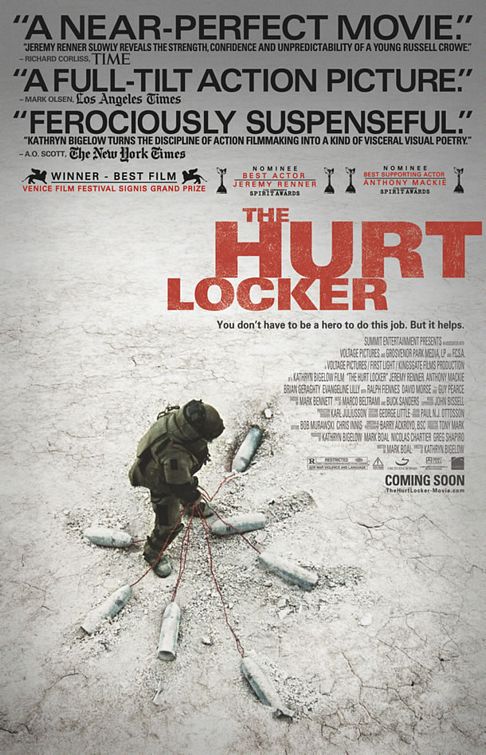
The Hurt Locker (2009)

Here's a film I've been meaning to see since about November that I just today finally got around to seeing. Unfortunately, the quality of the film did not correspond too well with my desire to see it. Hurt Locker is far from a bad movie, but it's also not at risk of being a masterpiece.

If I could describe Hurt Locker in as few words as possible, I would just call it a fantastic war movie. However, that's much different than calling it a fantastic movie. Apocalypse Now! is a movie set during a war, but I would never think of it as a war movie, because the inner struggles of the lead characters are so much more important than the actual war story. Same goes for a movie like The Thin Red Line or Rescue Dawn.

That isn't the case with Hurt Locker. The characters are all pretty well rounded, but almost all of the character development is saved until about the last half hour when all the characters have to suddenly come to terms with various issues. When resolution for the lead character finally comes, it's delivered in an unfortunately heavy handed speech to an infant while holding a jack-in-the-box. Best Picture material, naturally.

So, war movie. Under this criterion, the film shines gloriously. The audience never has to deal with dull generals, no scenes depict officials trying to create the perfect plan to defeat the enemy, nothing of that sort occurs. Instead, there is the simple concept that everyday brings new challenges, and in war, this means life or death. That makes the movie tense, as it often is. The movie follows a unit that neutralizes bombs (which the opposing forces seem all too willing to take their time in detonating).

I don't really know much about Kathryn Bigelow, but her direction here is pretty top notch (a quick glance at Wikipedia informs me that 1) she directed that surfer movie with Keanue Reaves, and 2) she was married to James Cameron, no doubt 2 mistakes). The cinematography is really quite excellent, and even the firefight scenes aren't especially dull thanks to the camera work.

As a film, I have no real complaints about The Hurt Locker. It's not a bad movie. I would even call it a good movie, but nothing more. It's not incredibly unique in its approach, but at least it isn't entirely riddled with cliche. Also, any movie that takes awards away from Avatar is fine by me. I think it fails in its lofty attempts to be a brainy war flick, but succeeds in separating itself from the glut of action heavy war movies. I would put it on par with a movie like Jarhead, which I actually thought was surprisingly good.

19 March, 2010

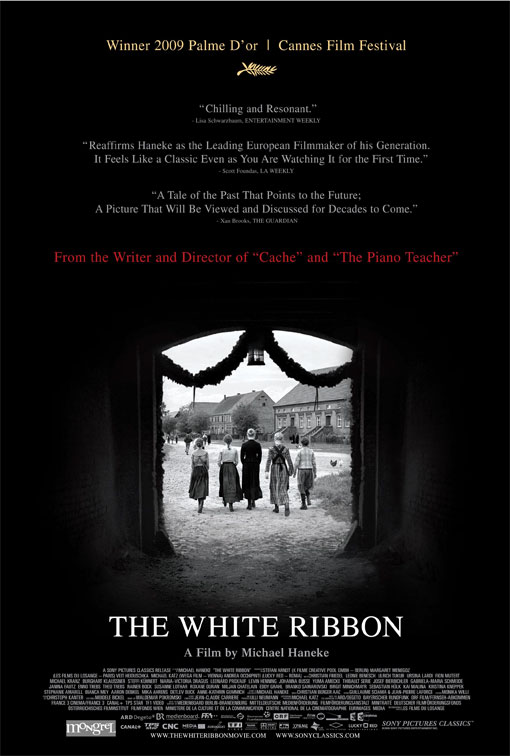
Das weiße Band (The White Ribbon) (2009)

Michael Haneke, to put it lightly, is difficult. His newest feature, (which unfortunately just came to Eugene this week) Das weiße Band, 2009 Golden Palm winner at Cannes, is no exception. The only way I know how to describe it is imagining Bela Tarr had directed Haneke's earlier film Cache, which made a surprising number of best films of the 00's lists.

The film moves at a very deliberate pace, yet never fails to engage. All the characters are fully developed. The dialogue is natural. The acting is tremendous, especially considering the extensive use of child actors in key roles.

It's the last point that I find most entrancing about the film (other than the spectacular camera work, a strong point in any Haneke film). The ensemble cast consists of a large number of children, and their acting generally outshines all but a few of their adult counterparts. Interestingly, the intrigue of the ability of these child actors is reflected in the perplexing narrative, which remains up for interpretation, as is generally the case in Haneke's films.

The movie itself tells the tale of a small German town on the eve of the first world war (a fact that's never really made clear until a character learns of Ferdinand's assassination about 2/3 of the way into the movie). In the town, a number of unexplained accidents happen, and the locals are terrified.

The viewer is left with nothing with questions by the end of the film. Like other Haneke films, the ultimate question is whether or not the questions the audience likely leaves with matter in the first place (I'm being intentionally vague in this review so as not to spoil anything). By not bringing reconciliation in an expected way, Haneke is really attacking the very cinematic idea of closure.

Haneke is a master filmmaker, and this is him at his finest. I'm not going to suggest that I was utterly blown away by the time the credits ran, but this movie really was next to perfect. From the preview, this made me think it would be something like The Village, without being awful. And in actuality, that's kind of what it was. Haneke presents the same kind of small village paranoia in a subtle way incomprehensible in mainstream American film as of late.

Given how incredibly excellent this film was (though, ultimately, I don't think it unseated Antichrist as my favorite film of 2009), I'm really excited to see
El secreto de sus ojos, which nabbed the Oscar for best foreign language film this year (at which point I turned off the TV to avoid having to look at James Cameron anymore).

15 January, 2010

Festen (The Celebration) (1998)

In 1995, Thomas Vinterberg and Lars von Trier released the Dogme 95 manifesto into the cinema world by means of flyers thrown at a Parisian audience during a talk von Trier was giving to commemorate the first century of film history. The most prominent feature of the manifesto (one of many that von Trier has written) is the "Vow of Chastity", which is a sort of 10 commandments for film. The list is simply ridiculous, with rules like cameras must be handheld (preferably digital), all music must be recorded live, no props are allowed unless they are found on the site, everything must be filmed on site, and greatest of all, the director can never be credited.

In 1998, Dogme #1 was released, Thomas Vinterberg's The Celebration. Dogme actually had a board certify the films, which can be found in numeric order on their website (though the group has since disbanded).

The Vow was intended to reintroduce the element of realism into film (assuming it wasn't simply an elaborate prank being played by von Trier and co, seeing as how many of the Dogme founders never directed more than one Dogme film). However, it simply works as a stylistic guide for a specific aesthetic. Were the Dogme filmmakers really concerned with the lack of realism in Hollywood movies, the omission of any rules related to editing seem to negate any attempted realism (jump cuts aplenty!).

With all of that said, Vinterberg's debut feature is an absolute gem. Winner of the Jury prize at Cannes that year, Festen was justly praised on its release. No matter how gimmicky the Dogme "movement" was, films like this almost justify its extravagant scope (I'm sure there are plenty of Dogme duds, but so far, I've seen 3 and loved them all).

As for the film itself, I think it might just be one of the most depressing pieces put to film. The movie is about a family and their friends gathered for the 60th birthday of their patriarch. Like all Danish families, no doubt, this one has an unbearably dark past. Just minutes into the film, we discover that the father's grown children, spread out in various walks of life, are recently recovering from the death of a sister. Her twin seems the most rattled, while the youngest brother apparently didn't even attend the funeral. Domestic squabbles and family revelations abound in this film.

The setup of the film reminds me very much of France's golden cinema cow, Jean Renoir's La Règle du jeu, a film whose reputation I've never quite agreed with, but is a worthwhile watch anyway. Basically, there is a house full of people who have unknowingly agreed to enjoy themselves no matter what, and one rebel who is out to reveal the demon in the crowd.

What makes Festen so successful is a few things. One is the stylized look, naturally. What would become trite in just a few years was new and fascinating at this point. Secondly, the utterly fantastic characters, who are more well rounded, flawed, tragic than any film I can recall. Finally, the unrestrained content of the film is really shocking. The issues discussed in this movie (which I will not speak too much of, I would much rather you see the film for yourself, and say "Oh my god!" just as I did) are simply not addressed in films, and I really wonder why.

What really shocked me about the movie, other than the family secrets being revealed, was the very subtle humor. While I would gladly describe the movie as utterly depressing, it definitely doesn't go without taking a few jabs here and there, and by the end, you kind of hate Danish people. Well, more than you already, naturally do.

12 January, 2010

The Imaginarium Of Doctor Parnassus (2009)

Terry Gilliam makes a movie with "Imaginarium" in the title and casts Tom Waits as the devil. This sounds as close to a slam dunk as a movie can be. Unfortunately, Parnassus is more of a shot clock violation. The ideas get passed around so much that Gilliam forgets to take a shot.

There is a lot to like in Gilliam's newest film, from the exquisite cast (minus Verne Troyer, who delivers his witty lines like a particularly bland board), to the premise of the film, which involves an immortal monk making wagers with Mr. Nick/Satan to protect his family, while the rest of the cast gets to spend a lot of their time inside a fantasy land.

However, the fantastic elements just aren't that imaginative. Maybe it was just CGI overkill, but I found the film to be at it's least interesting in the dream-like imaginarium, which should really be Gilliam's strength. And as dull as I found Avatar, that technology showcase masquerading as a narrative, actors submersed in CGI landscapes in any other movie just looks silly in comparison. Watching this after watching James Cameron's film, which undoubtedly cost the GDP of various small countries was like watching Jurassic Park on TV. Had this film not relied so heavily on these technical elements, it could have been much stronger, but instead gets handicapped by its already dated appearance.

I would consider myself a fan of Gilliam's work. Brazil is one of my absolute favorite films (watch for Brazil lead Jonathan Pryce to make a brief cameo during Parnassus). It's a well established fact that Gilliam knows his way around an imagination as only someone like Tim Burton could hope for (the jury is still out on whether Gilliam or Burton will make Johnny Depp: The Movie first). But Parnassus seems more like the uninspired work of latter day Burton than Gilliam, minus the fact that it's not a remake (not that Gilliam has been at the top of his game lately, and I'll admit to greatly enjoying Sweeney Todd).

All in all, Parnassus is a surprisingly tight narrative, with generally good acting, but it just never really becomes anything great. It's not Gilliam's worst film, but it's far from his best. I think of this more as a step in the right direction than a great movie. Gilliam is indeed returning to the silliness and imagination of his older movies, it's just a matter of quality that's the issue.

29 December, 2009

Avatar (2009)

Stock characters, heavy handed political messages, and ghastly production costs. This is indeed a James Cameron film. I will admit that I genuinely think Titanic was a piece of filmmaking brilliance, and Aliens was pretty good as well, but for me, Cameron's ability to make an interesting movie ends there.

Avatar is essentially Last of the Mohicans, Fern Gully and She's All That, made in Three Dimensions(!!!!). As a technical piece, it is unmatched in its visual spectacle. The movie just looks absurdly good. It's genuinely unsettling how detailed everything about the movie is.

At least everything about the movie that doesn't relate to characters or story. Other than the final battle scene, and just the general look of the film, there is really no redeeming quality to the movie.

The characters are characters you've seen from the last action movie you saw. They deliver the lines they are supposed to and either succeed or die in the end, though it's clear who does what. I cringed when the main character had to give his heart to heart to his lady interest that it only started out as a job, but he really was in love, with all the syrupy Freddie Prince Jr. sweetness he could muster.

I can't say I wouldn't recommend this movie, because it was a treat for my eyes. But paying $10 or whatever IMAX is charging to see it only encourages directors to keep producing these kinds of dull experiments in spending as much money as possible. And seeing as I paid to see this and Transformers II this year, I have more than done my part to make this world a slightly worse place, and for that, I apologize.

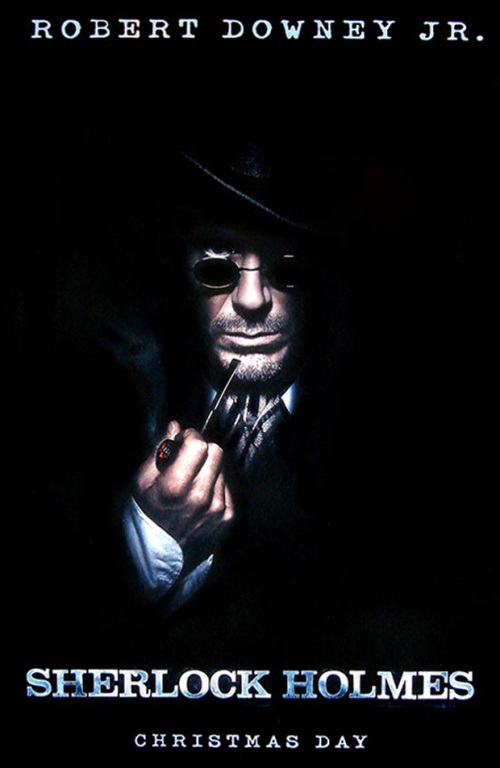
Sherlock Holmes (2009)

I loved Iron Man. Everyone loved Iron Man. So when I first saw a preview for the new Sherlock Holmes film, I thought, "Victorian Iron Man? Someone has been reading my book of dreams." This, of course, is not true as my book of dreams has long since been destroyed.

However, Sherlock Holmes is only the second film I've seen, other than Gone With The Wind, where I actually tried to fall asleep. My inability suggests more about my caffeine addiction than the viewing experience, as reading the back cover of my roommate's Iron Man DVD for an hour and a half would probably prove more exciting than watching Sherlock Holmes.

There really wasn't anything absolutely awful about the film, it's just that I had seen it already, and so have you. The movie is an explosion filled paint-by-numbers piece, which is odd since I always thought Holmes was more of a sleuthy type character. I must admit that I've never read any of Doyle's work, but I would have to assume this was nowhere near what he was writing about.

Robert Downey Jr is the one saving grace of the film, but even his performance was utterly disappointing. The man is not British, and when he fakes a British accent, half of his lines are unintelligible. The film was an attempt at the witty action film with heart (yeah, that's still you Iron Man), but fails miserably at this. The one or two laugh out loud moments are already in the previews, and the rest is just a matter of banal, CSI style crime investigation. But really, I went to this to get out of seeing Avatar, because if I'm going to be bored, I'd rather be bored for about an hour less. So I guess I can't complain.

07 December, 2009

Antichrist (2009)

Nature is Satan's church. Freud is dead. This is Antichrist, Lars von Trier's shocking horror film dedicated to the memory of Russian auteur Andrei Tarkovsky.

The film starts with a horrifically beautiful sex/death scene where the two main characters, played superbly by Willem Dafoe and Charlotte Gainsbourg engage in the sensual joys (and unlike most every film that isn't a porno, the sex scenes in Antichrist are unsimulated) while their son falls out of their apartment window. The film then follows the mother's grief while her husband, a therapist, tries to help her face her fears while keeping a clinical distance from his own wife.

The first half hour or so of the film is undoubtedly dark and depressing, illustrating the unrelenting grief felt by Gainsbourg's character, but it isn't until the couple gets to their woodland cabin, "Eden", that the film really asserts itself. Modeled after settings in Tarkovsky's autobiographic film The Mirror and his sci-fi masterpiece Stalker, Eden is the location for the films unbearably haunting second half.

I remember there being a big to-do about the graphic violence depicted in Mel Gibson's awful Passion of the Christ, but that film is tame by von Trier's standards. I'm not the kind of person that typically reacts physically to films, but in various parts of Antichrist, I came close to vomiting and crying. I spent entire scenes hiding behind my hands or staring at the wall to the left of the screen. And honestly, I kind of want to watch it again.

Asking whether or not the extreme violence and sexual content is necessary is certainly valid, and in this case, I believe that it is. I can't say I know what von Trier's intent with the film was, but if he set out to make a horror film, that's exactly what he did. I don't ever go to the theater to see horror films, but I can easily say that Antichrist is the kind of horror film that will stick with me for a long time. It isn't for the scenes of violence either, those are just garnishes to the actual horror that's happening between the two lead characters. Antichrist is little more than a remake of Bergman's Persona, drenched in blood from Willem Dafoe's penis.

My one complaint with the film was the computer graphics. I haven't seen any of von Trier's other films, so I don't know if it's typical of his work, but there was quite a bit of CGI in this film. It never looks bad, honestly, it just doesn't seem to fit in with the realism of the characters' struggles at the beginning of the movie.

I would highly recommend this film to anyone and everyone, assuming you can handle the numerous graphic scenes.

08 November, 2009

Once (2006)

I like Nick Cave a lot. In the last few months, The Bad Seeds have been in my CD player more than any other band, simply because their music is really, really good. I would consider myself a fan of Nick Cave, absolutely. However, I would never think to make a film based mostly on his music. Even if I introduce a few characters (perhaps a charming female lead?), the story would still undoubtedly be lacking, and the quality of the film would depend entirely on how much the viewer likes Nick Cave's music. Using his music for emphasis would be fine (Wings of Desire now available on Blu Ray!), but as a central theme? No thank you.

It is for this reason that beloved indie musical Once is pretty terrible. Take one part street crooner, one part attractive street vendor, add some agreeable, though otherwise unremarkable tunes, and you have a movie about a street crooner, an attractive street vendor and some agreeable, though otherwise unremarkable tunes.

The main character of the film is really the music. Like I said already, the music is far from bad, I might even listen to the soundtrack once in a while if I had it. But I'm not so enraptured by it that I would ever want to see a movie about it. The scenes in the film are really just written around the music, finding ways to allow the flat personalities to interact. Through song.

To its credit, Once is delightfully unpretentious. I don't think I've ever seen a movie so ready to present itself so matter-of-fact, just kind of hoping people would like it, without really expecting much from the audience. At the same time, I think a little pretension is needed. It's a film after all, trying to pretend the camera and crew aren't there and the film is merely happening is as hokey as an Ansel Adams photograph (note: Ansel Adams is just about the greatest photographer ever, but goddamn are his pictures painfully romanticized). Unlike another recent, awful musical, Across The Universe, Once really has nothing going for it outside the music. At least that film had a few neat music videos hidden among 2 hours of poor film-making. Once, on the other hand, feels as though it wasn't even directed, but merely occurred and was documented.

Also, the movie has a really dumb poster.

02 November, 2009

Satantango (1994)

I don't want to stress the length of Satantango too much in this review, so I think I'll just get it out of the way to begin with: 450 minutes . I'm unfortunately a bit impatient with movies, which surprises people a lot, so I had to split my viewing into three days, a day for each disk of the film. This undoubtedly takes away from the experience; Bela Tarr's films aren't so much about story as they are about mood. However, he is peerless when it comes to transporting the viewer to a different place, so it's almost eerie how I got sucked in after taking a day or two in between disks without missing a beat.

The basic plot of Satantango follows the arrival of a charismatic local who was previously believed to have died during an unnamed war that's pressing closer to the small, rural town. He convinces the farmers to create an agricultural society in exchange for their yearly wages. That's really the meat of the story. Like I said, Tarr's films aren't ever that focused on plot.

Tarr's moods are heart-breakingly entrancing. In more than one instance, the camera follows characters walking for what must be at least 5 minutes without any cutting. Tarr works only in long shots. Supposedly, there are a grand total of 150 shots in the entire film. That means an average shot length of 3 minutes, in case you were wondering but too lazy to calculate.

I find it interesting to compare Tarr's style with that of Gus van Sant, who's film Elephant also featured a number of lengthy shots of characters walking. However, where Tarr's scenes actually add to the atmosphere of the film, van Sant's serve only to remind us of how bland high school hallways are (I really, really hate Elephant. It's currently tied with Reservoir Dogs on my list of movies I never, ever want to see again).

The film is divided into a number of different sections, each focusing predominantly on a single character. Like Reservoir Dogs, the viewer sees the same actions happen numerous times from different perspectives, but unlike Tarantino's film, these scenes don't do much for the plot, they just strengthen the characters by adding significant amounts of depth. I'll admit that I'm entirely biased and think that Tarantino is incapable of making a good film, so I should probably stop using him as an example to explain movies I like.

In these character vignettes, all the motives and actions of the characters are explained and examined. No character is quite as interesting as the doctor, who writes down the activities of the locals in small notebooks. The doctor is morbidly obese, making it ironic that the only character capable of observing life is the most incapable of actually living it.

Satantango is undoubtedly the most complex film I've seen since Inland Empire. Tarr does a very good job mixing a sense of humor that's darker than a moonless midnight with scenes that will actually make you feel really, really uncomfortable. No scene accomplishes this more than one chapter (Those Coming Unstitched, I believe). For about 20 minutes, the viewer is subjected to a hooker's daughter forcing her pet cat to bend to her will, having nothing else that she can physically dominate in her environment. If Tarr hasn't received any PETA death threats for this scene, I'd be amazed. With that said, I'm not sure there's any better filmed segments in the entire film.

I'm sure the length of the film will turn off most viewers, but I must assure anyone interested that the film doesn't drag (unless you simply cannot stand his ultra-slow style of filmmaking). I can remember a grand total of 3 shots in the entire film that I feel should have been shortened or omitted. Even with heavy editing, I can't imagine making this film under 6 and a half hours long.

As a final statement, I have to admit that despite its lofty ambitions, its flawless presentation and its incredible atmosphere, I would recommend his follow up film Werckmeister Harmonies over Satantango. Two great films, but Werckmeister just has something special that I can't figure out (it might be a rotting whale corpse).

14 October, 2009

New Reviews Coming Soooooon

I've been bad about updating this lately, but hopefully I'll have a review of Bela Tarr's Satantango up soon, at least as soon as I finish it. Until then, enjoy the opening scene/possibly my favorite shot in any movie ever from Bela Tarr's followup to Satantango (and one of my alltime favorite films) Werckmeister Harmonies.

10 September, 2009

Antoine Doinel (1959, 1968, 1970, 1979)

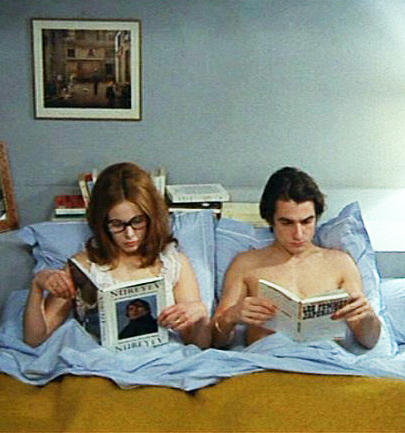
Francois Truffaut helped spark one of cinemas greatest movements in 1959 with the release of Les quatre cents coups (The 400 Blows), heralding the start of the French New Wave. A semi-autobiographical tale, The 400 Blows tells the story of 12 year old Antoine Doinel, a trouble making preteen who runs amok in Paris. Not intended as the beginning of a series, The 400 Blows eventually sparked 3 feature length sequels, and one short film. Enough has undoubtedly been said about The 400 Blows, astoundingly good for being Truffaut's debut feature (though arguably topped by his colleague and friend, Jean-Luc Godard the next year with the release of A bout de souffle). However, for those new to the film (as I was just a few months back), it's absolutely require viewing for anyone interested in world cinema.

Starting with Baisers voles (Stolen Kisses) in 1968, the second feature length and third overall film in the series, Truffaut expanded upon Doinel's character, giving more control to the unbelievably charismatic lead, Jean-Pierre Leaud. Whereas The 400 Blows was fairly serious, Stolen Kisses is really, really funny. While 400 is undoubtedly the masterpiece of the series (and one of the greatest films ever, really), I actually prefer the later, lighter films. Leaud's comic acting is undoubtedly the cause of this.

Stolen Kisses, Domicile conjugal (Bed and Board) (1970), and L'amour en fuite (Love on the Run) (1979) shift the focus from the childhood rebellion of The 400 Blows to telling of Antoine's various love affairs throughout his life and his bizarre, constantly changing occupations. The real treat of the series is the cast, which stays the same for every movie. By Love on the Run, Leaud is 20 years older than he was during the filming of The 400 Blows. The viewer really gets to see the actors growing up, which is delightful. Unfortunately, Truffaut noticed this too, and made Love on the Run into a scrapbook of memories rather than a movie. About half of the film is flashbacks, which means scenes from other films in the series. This could be done interesting and well, but as even Truffaut would admit, he failed in this regard. Still, the material that is new is just as good as the previous films.

I think the Antoine Doinel series, available as a box set from Criterion, has to be my favorite film series. Truffaut's scripts are phenomenal, from the scenes of a family struggling to stay together in The 400 Blows to the scenes of Antoine bouncing around from job to job in the later films. The real treat has to be Leaud's acting, which was also put to good measure in a number of Godard's films. I can't tell if he's a great actor or just plays characters close to his own personality, but he's a lot of fun to watch. I would probably recommend The 400 Blows only to people interested in foreign classics, but I can't imagine many people disliking Stolen Kisses or Bed and Board.

Uzak (Distant) (2002)


As an aspiring filmmaker that lacks any especially spectacular ideas for films, movies like the Turkish Uzak are inspirational. To put it simply, Uzak is just about people being people. Granted, these people are painfully lonely, but no scene in the film feels out of place from a normal day. This is the least cinematic film I've ever seen.

By no means am I suggesting that it's bad. In fact, I think Uzak will make my eventual list of the best films I've seen from this century. However, the subject matter is wonderfully banal. It was filmed exquisitely, and is one of the more beautiful films I've seen in a while. By calling it uncinematic, I simply mean that nothing in the movie seems to fit the usual mold of what people make movies about.

The movie follows to characters in Istanbul, one an established photographer in the town, the other a friend from a village coming to find work. Long scenes show the two characters watching TV, eating alone at a restaurant or simply walking around snowy Istanbul. Their solitary existence is all too easy to relate to (though the shots of the characters walking through parks and only seeing happy couples at play was a bit heavy-handed). Granted, they are fond of following attractive women around, but minus their occasional creepy habits, the characters seem like people you probably know, or even people who write rarely read movie review blogs.

Like a number of movies I've written about, I can safely say that this is not a film for everybody. Nothing really happens. Not to say there is no story, but to reiterate, the film is uncinematic and there are no twists, no major plot points, nothing common place in most films. This feels almost like the work of a director unfamiliar with movies. Rather than making a movie about movies, as most movies seem to be, Uzak is really a portrayal of the actual banality of existence.

21 August, 2009

Revolutionary Road (2008)

Some months ago, a friend and I headed to the theater to go see Revolutionary Road. I can't remember why exactly, but we somehow showed up about half an hour late to the theater, and instead settled on the utterly mindless Underworld prequel (never mind the fact that I hated the first one). Having come at a stressful week in school, this was a welcome vacation for my brain. Very few things require less thought than a movie made by a former special effects coordinator about a war between vampires and werewolves, even if the main werewolf had just recently been absolutely amazing in the movie that probably should have won best picture at last year's Oscars, Frost/Nixon.

Fast forward a few months, and I'm sad to report, that delay in arriving to the theater was something of a blessing. I'm sure if I was some sort of movie journalist, I would lose my job for saying this, but Underworld was monumentally better than Revolutionary Road.

I simply cannot understand A) how this movie got good reviews, and B) how Kate Winslet won any awards for her performance. She's one of my favorite actors currently working (as evidenced by the giant Eternal Sunshine poster of her face on my wall), but she, as well as DiCaprio, do a lot more play acting than film acting. None of their movements, none of their lines, none of their interactions look like anything two people would actually ever do. They look like they are acting; the movie feels too much like its a movie. The acting is very, very stiff (when the two leads aren't overacting), and the dialog is often perplexingly bad (for example, during an argument on the beach, DiCaprio ends it by taking off his shirt saying something to the effect of "It's too hot for this, I need to get wet").

Mediocre performances aside (I still cannot wrap my head around how Winslet got nominated and won awards, I just can't do it), director Sam Mendes ruins what I assume is a pretty good novel. The film basically tells the story of a couple achieving the American dream and discovering that the status quo isn't actually fulfilling, as their marriage quickly falls to pieces. Where there any other revelations or themes anywhere in the entire movie, maybe this film would have a chance to be something special. But no, Mendes lingers on the one, earth-shattering realization that living in the suburbs isn't the dream everyone is chasing. I'm 21, never been anywhere close to marriage, and these ideas seem all too obvious to me, yet Mendes presents them as though the audience would never have considered them before.

And that makes me wonder, are the people watching Revolutionary Road as slow to understanding as the characters? I think Mendes' intention was to be, well revolutionary, and shake up a few minds to realize that maybe they aren't living the way they want to live. But if they need a movie to point this out to them, a shallow, dull movie, I suppose they deserve their shallow, dull lives (I however, quite like my shallow, dull life, and wouldn't trade it for the world).

Sånger Från Andra Våningen (Songs From The Second Floor) (2000)

It's safe to say I have a thing for Swedish films. I assume this is only because Norway's cinema doesn't have the same worldwide renown (though I am eagerly awaiting O'Horten to finally come to a goddamn theater near me). There's just something about really cold people in films that really speaks to me, apparently (this might explain why I also like Canadian Bacon). But I think Sweden is special. Like France, which just has that unique, French quality, Swedish films seem to thrive by being so Swedish.

Songs From The Second Floor is very Swedish. The movie moves at the current walking speed of Ingmar Bergman (hint: he's been dead for 2 years), I don't think there is a single camera movement in the entire film, and everything about it is bleak. It's also remarkably funny. I'm not sure I would go so far as to call this movie a black comedy, but I think that would be a fairly good description.

The movie is something of a modern dystopia. The economic scene in Sweden is less than favorable and everyone is trying to leave the unnamed location of the film without any explanation.

What really makes this movie special is the complete surreal world director Roy Andersson creates. The sets look real enough that you could not notice how much of the film was shot in studios (I'm guessing almost all of it), yet the backgrounds also look like muted stock from Edward Hopper paintings. This film really brings to mind the outrageous spirit of Spanish auteur Luis Bunuel, with a reserved Swedish delivery. Additionally, these sets are supported by the bizarre happenings of the film, which range from an unexplained fire to a human sacrifice, all within an enclosed, corporate world.

Definitely not a movie for the impatient viewer, Songs presents a lot of potential frustration if not seen in the right mood. The humor is delivered in deadpan stares, similar to a Wes Anderson or Jim Jarmusch affair. To give you an idea of possible reactions to this film, I heard of it when two classmates were discussing it in my Norwegian class, having seen it in their Scandinavian film class. One student asked the other "You actually liked that movie?" Similarly, while I laughed quite loud throughout quite a bit of the movie, my mother who was watching with me, fell asleep a number of times during the films duration. It's one of the few movies I've seen recently that I was sad to see end, but for some, I'm sure the hour and a half run time seems closer to an eternity.

Adam (2009)

I remember seeing a trailer for Lars and the Real Girl a few years back and thinking, "that looks fantastically bad", though I had a secret hope that it would somehow be excellent. I was eventually talked into seeing it, and truth be told, I nearly cried during it. It's an absolutely phenomenal film about a guy who just doesn't understand human interaction. As someone with some anxiety issues, I can certainly relate, though not on the same scale of course, and I felt quite touched by the inevitable happy ending. When I read the synopsis of Adam, Max Mayer's second film according to imdb, I thought to myself "this looks like Lars with Aspergers".

And it was. Just not as good. Adam has Aspergers. Adam also has a gorgeous neighbor (Rose Byrne), who wants to help him like the pilot helps the Little Prince in the fantastic story of the same name, as mentioned in the opening narration. Unfortunately for Adam, he's stuck both in his head and in a formulaic romantic comedy (amusingly, Hugh Dancy, the lead actor, didn't realize this until late in the shooting).

As a result, you know when you sit down what is going to happen. You know that Byrne's character is going to fall for Adam's quirks, and you know when Adam just isn't going to understand the situation and fly off the handle. You know how the film ends already (well, you can narrow it down to a few possible choices). With all that said, I enjoyed Adam.

Similar to a movie like Once, Adam is joyfully unpretentious. Unlike Once, there is actually some content to the movie to make it worth watching other than the delightful leads. Also unlike Once, I would actually recommend this movie to other people. The central issues of the film seem important to the director, and his sincerity more than makes up for the shortcomings of the production. And even when some holes are too big to be covered up, there are absolutely fantastic performances on display by the two leads, as well as Adam's lone friend and the films main source of humor, Harlan.

I would ultimately say that this isn't a film that really needs to be seen in theaters. Just wait a few months for it to be a 99 cent rental at Blockbuster, and enjoy it for its successes. Ideally though, you could just rent Lars and the Real Girl instead.

16 August, 2009

4 luni, 3 săptămâni şi 2 zile (4 Months, 3 Weeks and 2 Days) (2007)

I could simply tell you, dear reader, that 4 Months, 3 Weeks and 2 Days (winner of the prestigious Palme d'Or at Cannes in 2007) is the best film you will ever see about the subject of abortion set in communist Romania, or, I could simply tell you it's one of the best movies you will ever see.

This film is kind of like a realistic horror movie, where issues that real people might actually encounter provide the fear, as opposed to masked, chainsaw wielding camp counselors/aliens/masked, chainsaw wielding aliens. It's among the most intense films I've ever seen. What makes it so insanely nerve racking is the hyper-realistic approach the director takes in telling this story. I wouldn't say it was done in a documentary style by any means, but it was shot in a way that I haven't really seen before. Numerous scenes consist of only one or two very long takes where the characters have entire conversations, generally not relating to the story at hand, for example, a scene at a dinner table where the camera focuses in only on the main character and her boyfriend while his family is having a full conversation around them. We really get a sense of their discomfort, which quickly becomes our own. The director hasn't said that these two people are unhappy, he is showing us.

To call this simply a movie about abortion would be highly misleading. That would be like calling Let The Right One In a vampire movie. Yes, vampirism was crucial to the story, but no, that's not what that film was about. Similarly, abortion works works as a synecdoche for the oppressive constraints during Romania's time under communist rule. Evidence to the fact that abortion isn't the main issue of the film is the simple observation that the character getting the abortion isn't even the main character.

If I had to give a concise description of this film, I would describe it as a film with the beauty of the later works of Krzysztof Kieslowski with the tense horror of a Michael Haneke film. It's a horror film based entirely in reality. The superb acting and astounding camera work help make this among the best films I've seen from this entire decade (right now I'm thinking it's second only to There Will Be Blood).

Hannah And Her Sisters (1986)

I rented this knowing very little about it, other than it was a Woody Allen movie that had been nominated for Best Picture. Knowing that it was one of Woody Allen's good movies was enough to make me want to watch it, but I had expected it to be something of a comedy. It definitely has its laugh out loud moments, but to my surprise, it is so much more than that. I am tempted to call this my favorite Woody Allen film, though it would definitely be hard to put it over Manhattan, which is damn near perfect.

What this film has that I don't see in Annie Hall or Manhattan is maturity. Those movies are a little bit more about middle-age relationships, while Hannah deals almost exclusively with marriage and family. Also, this film has one thing that no other Woody Allen film has, Max von Sydow.

Allen casts Sydow as a brooding, misanthropic artist. It's a fairly minor role, but it's one of a number of great performances that make the film excellent beyond its already wonderful script. Michael Caine really steals the movie as the alduterous husband of Hannah, played touchingly by Mia Farrow. Woody Allen also turns in a good performance as a TV writer struggling with the possibility of death.

His existential crisis plays alongside Caine's regret and infidelity, similarly to the structure of one of Allen's other great films Crimes and Misdemeanors, where Allen, a documentary director questioning his integrity as an artist, has his story compared with the much darker story of a man driven to murder. I was at a baseball game tonight thinking about the final scene of that movie, and I felt absolutely crushed (but not for too long, as the Diamondbacks were about to beat the Dodgers).

Allen's character is largely superfluous, but adds themes and tangents that the film would be missing without it. His part in the movie is almost like Woody Allen deciding to direct his own Seventh Seal, playing out his fear of death on the screen just as Bergman did in his classic film (that would make sense as to why this of all his films, was the one that he cast von Sydow).

The more I think about it, the more I consider it among the best films I've ever seen. I would definitely need to see it again before being too sure about my thoughts on it, but it is absolutely a must see for fans of Woody Allen, or just anyone looking for a good movie. And if nothing else, you'll do a double take the first time you realize that Carrie Fisher actually exists outside of Star Wars.